
Website vs Property Portals: Where Should Estate Agents Invest More?


If Rightmove disappeared tomorrow, would your agency still generate enquiries?
Property portals like Rightmove and Zoopla have become an essential part of the industry’s marketing strategy. They offer instant visibility, attract millions of property seekers every month, and make it easier for buyers to discover available homes. For many agencies, they’re the single biggest source of enquiries.
But that convenience comes with an important question.
What happens when most of your enquiries come from a platform you don’t own?
Every year, portal subscription fees continue to rise; competition between listings becomes more intense, and agencies have little control over how their properties are displayed alongside dozens of competitors. Meanwhile, many estate agency websites remain little more than digital brochures -rarely updated, difficult to find on Google, and generating only a small percentage of direct enquiries. This has created a genuine business dilemma for agency owners.
Should you continue investing heavily in property portals, or is it time to build your own long-term lead generation engine?
The answer isn’t as simple as choosing one over the other.
The most successful agencies don’t treat their website and property portals as competing channels. They understand that each serves a different purpose and knowing where each delivers value can significantly improve your marketing return over time.
In this guide, we’ll explore:
- Whether estate agents still need their own website in 2026.
- What property portals do exceptionally well and where they fall short.
- How to generate more direct enquiries without relying entirely on third-party platforms.
- Where your marketing budget is likely to create the greatest long-term value.
Let’s begin by understanding why property portals became so dominant in the first place.
What Exactly Is a Property Portal and Why Do Estate Agents Depend on It?
If you’ve bought, rented or sold a home in the UK over the last decade, you’ve almost certainly used a property portal.
Platforms like Rightmove, Zoopla and OnTheMarket have become the starting point for millions of property searches. Instead of visiting individual estate agency websites, buyers can compare hundreds of properties, filter by location, budget and property type, and contact agents all from a single platform.
For estate agents, the appeal is obvious. Property portals offer immediate exposure to an audience that’s already looking to buy or rent. Rather than spending years building website traffic from scratch, agencies can place their listings where buyers are already searching.
It’s one of the reasons property portals have become such an important part of the UK’s property ecosystem. The numbers reflect that dominance.
According to Rightmove’s 2025 Annual Report, consumers spent 16.8 billion minutes on its platform during the year, and well over 80% of all time spent on UK property portals was spent on Rightmove. Rightmove also states that more people begin their property search with the term “Rightmove” than with the word “property” itself, highlighting just how deeply the platform is embedded in consumer behavior. That kind of reach is difficult for any individual estate agency to replicate.
But visibility isn’t the same as ownership.
This is where many agencies begin to rethink their strategy.
When someone discovers your property on a portal, they’re also shown dozens of competing listings often from agencies operating in the same area. Your brand becomes one option among many, and the customer’s attention can shift with a single click. The portal owns the audience and controls the experience.
And because the customer relationship begins on a third-party platform, agencies have limited influence over what happens before or after that first enquiry.
That’s not a criticism of property portals they’re designed to help buyers compare properties efficiently. But from a business perspective, it’s an important distinction. Visibility and ownership are not the same thing.
Do You Really Need a Website If You’re Already on Rightmove or Zoopla?
At first glance, the answer might seem obvious.
If most of your enquiries already come from property portals, why invest additional time and budget into your own website? It’s a fair question and one many estate agency owners ask, especially when portal advertising already represents a significant monthly expense.
The reality, however, is that property portals and your website are built to do two very different jobs.
A portal helps people discover a property. Your website helps them choose your agency. Understanding that distinction is key to building a sustainable marketing strategy.
What Property Portals Do Exceptionally Well

There’s a reason why platforms like Rightmove and Zoopla remain central to the UK property market.
They provide immediate access to buyers and tenants who are actively searching, making them one of the fastest ways to generate visibility for new listings.
Their biggest strengths include:
- Massive audience reach – Millions of buyers begin their property search on major portals every month, giving agencies instant exposure without having to build traffic themselves.
- High purchase intent – Most visitors are already looking to buy, sell, or rent, which means the enquiries tend to come from people further along in the decision-making journey.
- Speed to market – New listings can become visible to a large audience within a very short time, helping agents generate interest quickly.
- Search convenience – Buyers can compare properties, locations, prices, and features from multiple agencies in one place, making portals a natural starting point for property searches.
For many agencies, these benefits make property portals an essential marketing channel rather than an optional one.
Where Property Portals Have Their Limits
Despite their strengths, relying on portals alone creates challenges that become more noticeable as an agency grows.
1. Every listing competes for attention
A buyer viewing your property is usually only one click away from seeing similar homes listed by competing agencies.
The portal promotes the property not necessarily your brand.
2. You don’t own the customer journey
The first interaction often happens on a third-party platform.
That means you have limited control over how buyers discover you, what information they see first, and how they continue engaging with your business beyond the initial enquiry.
3. Visibility depends on ongoing subscription fees
Unlike investments in your own digital assets, portal visibility generally continues only while you’re paying for the service.
Your listings benefit from the platform’s audience, but you’re not building an asset that grows independently over time.
4. It’s harder to build long-term brand recognition
Many buyers remember the property they viewed but not always the agency that listed it.
Without a strong website and online presence, it becomes more difficult to encourage repeat visits, referrals, or direct enquiries in the future.
Why Your Website Still Matters
A common misconception is that an estate agency website exists simply to display property listings.
Today, it has a much broader role.
A well-maintained website becomes the centre of your digital marketing efforts by helping you:
- Build credibility through testimonials, local expertise, and valuable content.
- Rank on Google for local property searches and informational queries.
- Publish neighbourhood guides, market updates, and buyer resources that attract visitors before they’re ready to contact an agent.
- Capture direct enquiries without relying solely on third-party platforms.
- Strengthen your brand so potential clients remember your agency not just the property they viewed.
Unlike a portal listing, the value of your website continues to grow as you add useful content and improve its visibility in search results.
How to Get More Direct Enquiries Through Your Website
Having a website is only the first step. The real value comes from turning it into a channel that consistently attracts visitors and encourages them to get in touch.
The most successful estate agencies don’t rely on their website as an online brochure. They treat it as a 24/7 business development tool; one that answers questions, builds trust, and captures enquiries even outside office hours.
Here are five practical ways to make that happen.
1. Create content that people are already searching for
Many potential buyers and sellers don’t begin by searching for an estate agent. They begin with a question.
For example:
- How much is my house worth in Manchester?
- Best areas to live in Birmingham
- How long does it take to sell a house in the UK?
- What documents do I need to sell my home?
Publishing high-quality content around these topics helps your website appear in Google before someone is ready to contact an agent. Over time, this builds both visibility and trust.
2. Make every page easy to convert
Traffic alone doesn’t generate enquiries, action does.
Whether someone lands on a blog, a property page, or your homepage, the next step should always be clear.
Your website should make it easy to:
- Book a property viewing
- Request a free valuation
- Call your team
- Send an enquiry
- Start a live conversation
The fewer clicks it takes to contact you, the better your chances of converting interest into an enquiry.
3. Build trust before asking for contact details
People rarely choose an estate agent based on listings alone. They look for signs that your agency is knowledgeable, experienced, and easy to work with.
Your website should highlight:
- Verified Google reviews
- Recent client success stories
- Local market expertise
- Team profiles
- Industry accreditations
- Clear explanations of your buying or selling process
When visitors trust your agency, they’re far more likely to reach out.
4. Optimise for local search
Most property decisions are location-based. That’s why local SEO is one of the most effective ways for estate agencies to generate direct enquiries.
Instead of trying to rank for broad terms like estate agent, create pages that target specific locations and services, such as:
- Estate agents in Leeds
- Property valuation in Bristol
- Houses for sale in Reading
- Letting agents in Nottingham
These searches often come from people who are ready to take action.
5. Respond while interest is highest
Even the best website can’t help if enquiries go unanswered. Research consistently shows that businesses that respond quickly are more likely to convert leads because prospects often contact multiple companies before making a decision.
Consider how your agency handles enquiries:
- Outside office hours
- During weekends
- On public holidays
- During busy periods
Fast, consistent responses create a better customer experience and reduce the chances of losing potential clients to competitors.
A simple framework to remember
Instead of thinking of your website as a place to display properties, think of it as a system.
People search on Google → They find your content → They trust your expertise → They contact your agency → You convert the enquiry.
The goal isn’t simply to attract visitors it’s to guide them from their first question to their first conversation with your team.
Portal Fees vs Website Investment: Which Gives Better Long-Term ROI?
This is the question every agency owner eventually has to sit with, calculator in hand.
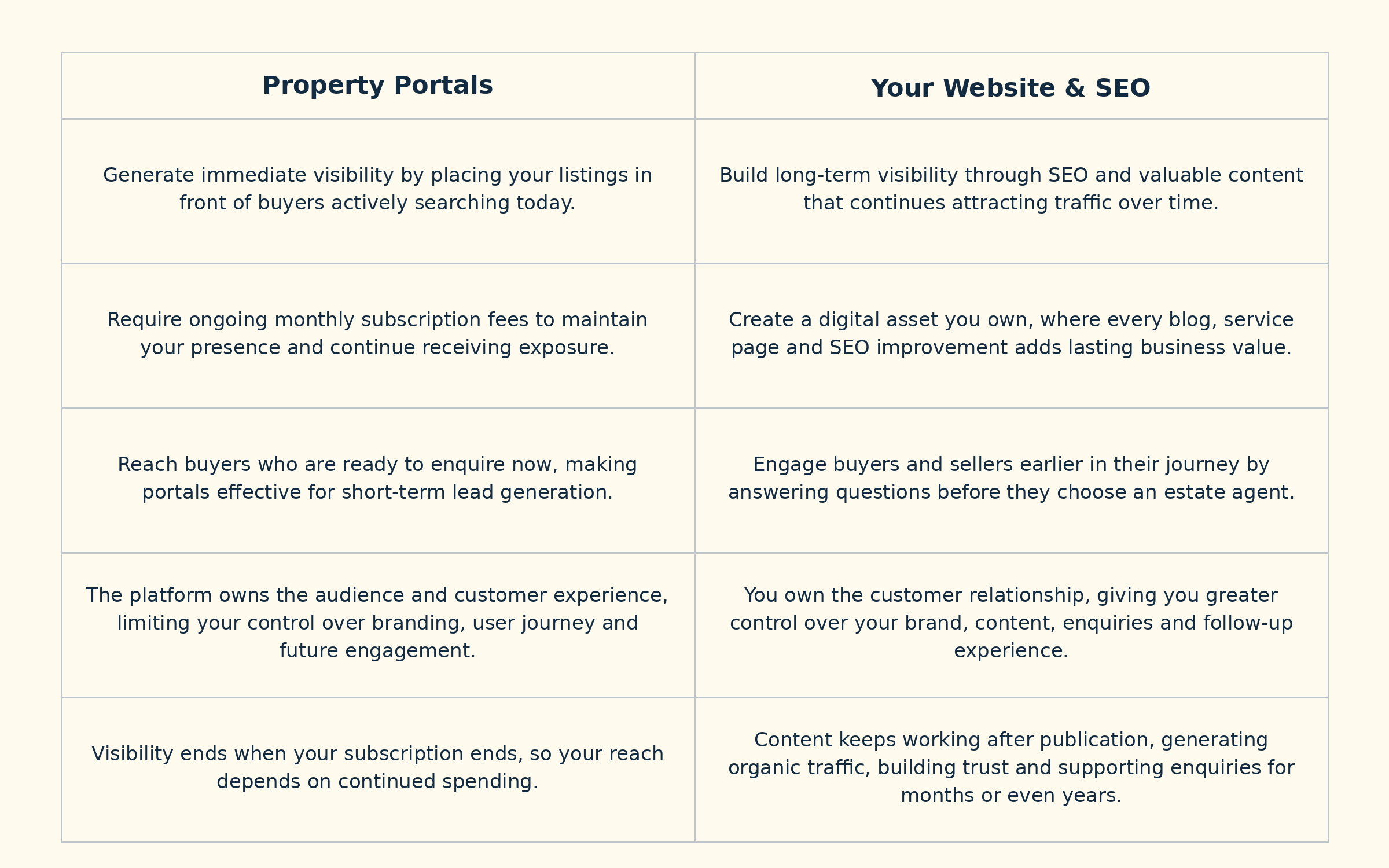
Portal fees are a fixed, recurring cost. A single branch typically spends over £1,000 a month on Rightmove alone, and that figure only goes up year on year regardless of how many enquiries it actually produces. You’re renting attention, and the rent never goes down.
A website works differently. The upfront investment in SEO and content can feel slower to show results, but every guide, valuation page, or area profile you publish keeps working for you long after it’s live. A blog post written this month can still be bringing in enquiries two years from now. A portal listing stops working the moment you stop paying for it.
This is precisely why the gap between agencies is widening. According to UK industry research from The Voice of the Agent one of the most respected annual surveys in the sector, run by We Are Unchained the average estate agency currently allocates around 10.4% of its marketing budget to activity outside portals, with roughly 62% still going to portals themselves (Property Industry Eye). Separately, independent UK agencies typically invest somewhere between £500 and £2,000 a month in SEO, with larger agencies in competitive markets spending considerably more
Portals are brilliant at one thing: putting your listing in front of someone who’s actively looking, today. The moment it’s live, it’s working. But the moment you stop paying, it stops existing.
Final Verdict
Here’s an interesting irony: every day, estate agents help clients understand why owning is often better than renting because it builds equity, gives you greater control, and creates long-term value. Yet many agencies still depend on third-party property portals for most of their enquiries.
For estate agents, the debate was never really about websites versus property portals. It’s about building a marketing strategy that delivers results today while creating value for tomorrow. Property portals like Rightmove and Zoopla remain one of the fastest ways to reach active buyers, and for most agencies, they will continue to play an important role. But unlike portal subscriptions, your website is a business asset that grows over time. Every blog you publish, every customer review you earn, and every improvement you make to your online presence strengthens something that belongs entirely to your agency. The most successful estate agencies don’t choose between portals and their website; they use portals to maximize visibility today while investing in a digital presence that continues generating trust, enquiries, and opportunities long into the future.
About Eumentis AI
You’ve built the trust. The enquiry finally comes in. And then a missed call at 7pm, a form that sits unread till Monday, a lead that quietly enquires with your competitor instead.
That’s the gap Eumentis AI closes. Our AI Voice Agents answer every call, qualify every lead, and book the viewing instantly, any hour, any day so the enquiry you worked so hard to earn never goes cold waiting for office hours.


