
VR/AR Property Tours: Immersive Buying in the United Arab Emirates

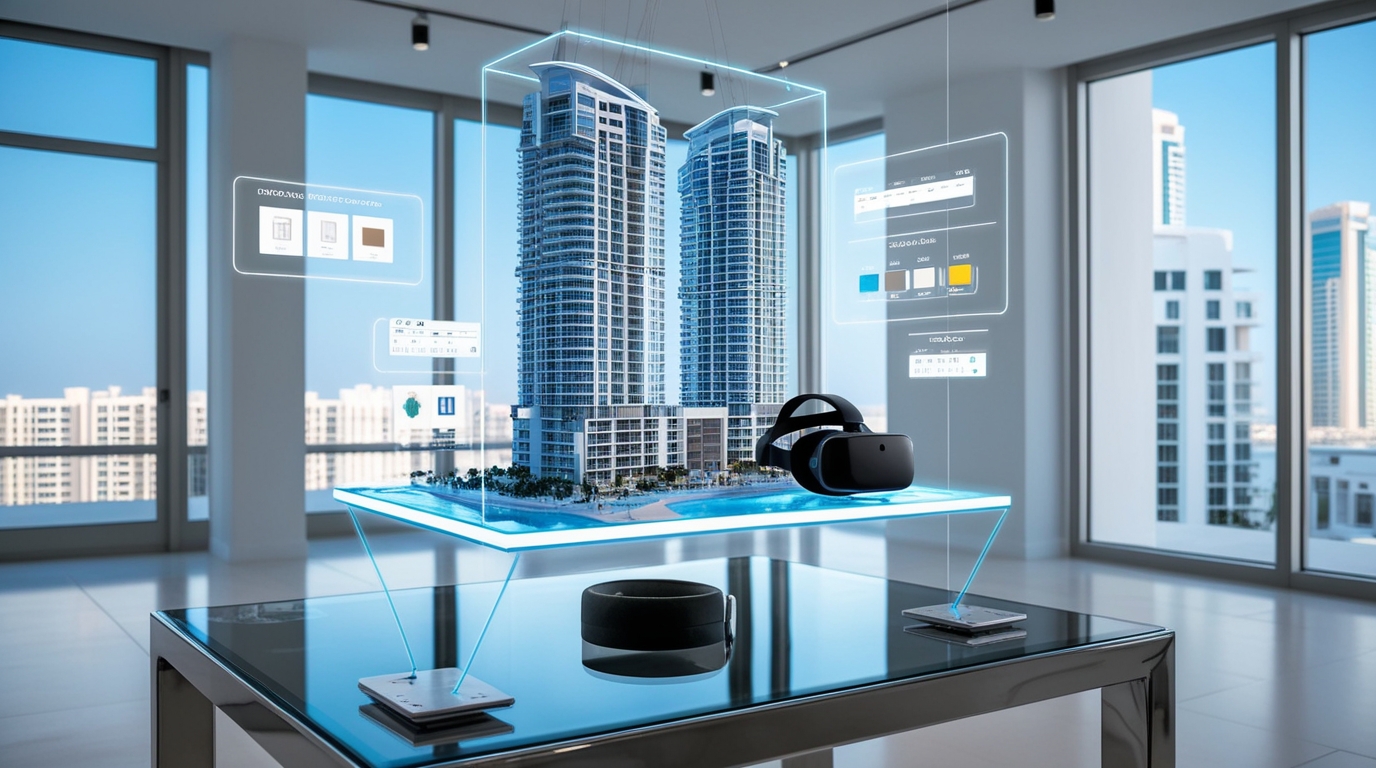
The Rise of VR Real Estate Tours in the UAE
The UAE real estate market has always been fast-moving, but the last decade has accelerated a transformation in how buyers—particularly foreign investors—discover, evaluate, and commit to properties. Public bulletins released by the Dubai Land Department (DLD) consistently show that a significant share of Dubai’s residential transactions involve overseas buyers. Many of these buyers shortlist properties entirely online before even considering a visit.
This shift in behaviour has amplified demand for immersive digital experiences, especially during off-plan launches when actual units do not yet exist. Developers increasingly rely on Virtual Reality (VR) and Augmented Reality (AR) to communicate spatial accuracy, finish quality, community scale, and even future ambience. Meanwhile, buyers expect precise, interactive previews that reduce uncertainty and save time.
In a market where launches often sell out quickly and multiple buyer nationalities must be catered to simultaneously, VR and AR have evolved from optional marketing tools to integral parts of the UAE’s property buying experience.
What Are VR Real Estate Tours & How Do They Work?
What Are VR Real Estate Tours & How Do They Work?
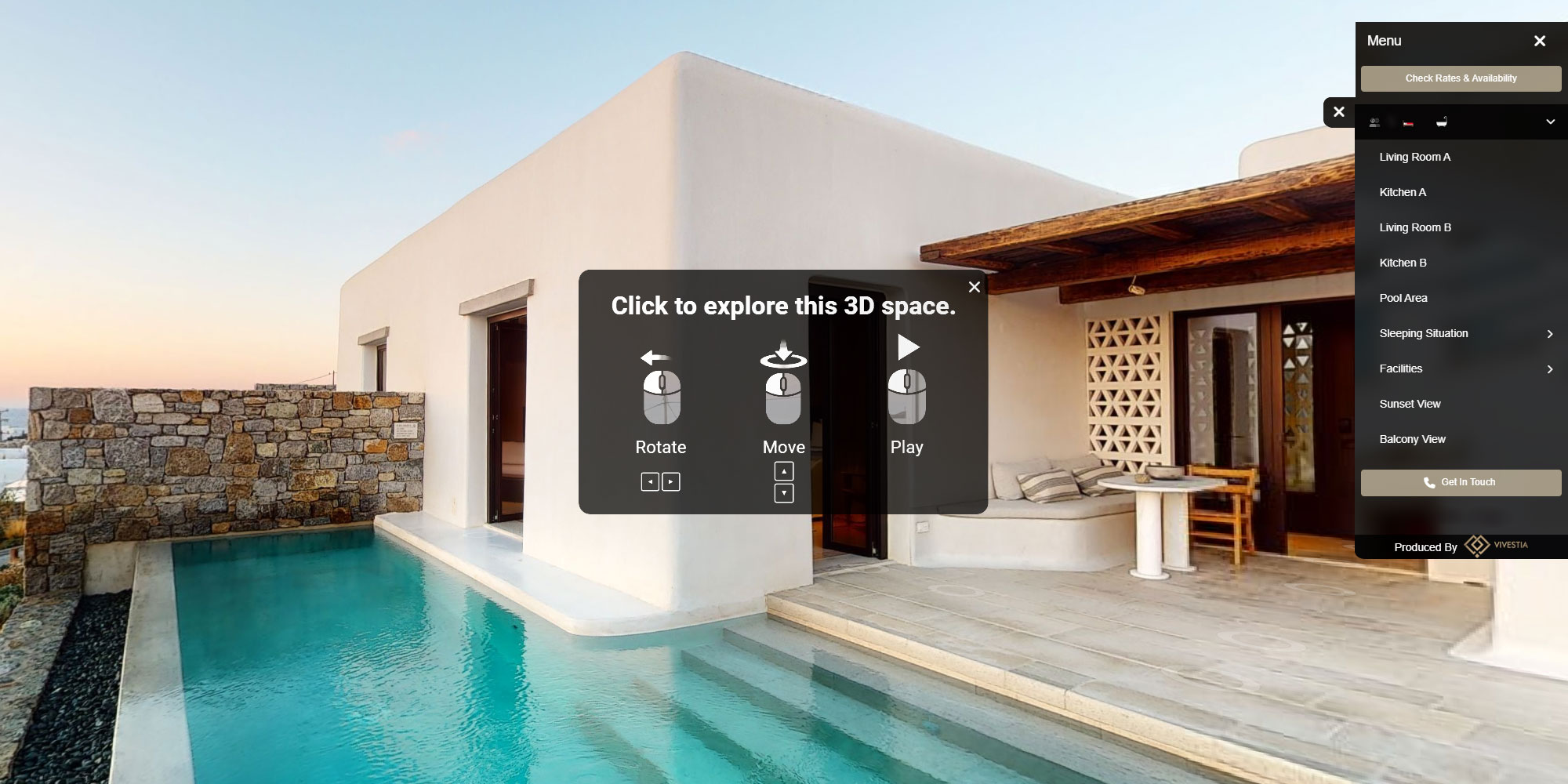
VR real estate tours allow a buyer to “step inside” a digital version of a property. Unlike static images, VR shows the scale, flow, and feel of a space, making it easier to understand proportions—an essential factor in apartment-heavy cities like Dubai and Abu Dhabi.
How VR Tours Are Constructed
VR experiences are created using:
- 360° cameras for ready or nearly-ready units
- LiDAR or Matterport scanning to capture dimensions with high fidelity
- Architectural CAD/BIM models to recreate off-plan units
- Rendering engines (Unreal/Unity) for realistic lighting, shadows, textures
- Post-production tools for optimisation
- Device-specific compression to ensure smooth VR performance on mobile or desktop
High-end VR tours often include:
- 4K–8K textures
- HDR lighting
- Simulated morning/evening natural light
- Global illumination rendering
- Animated elements like curtains, water, trees
These details make VR materially more trustworthy than static renders.
How Buyers Access VR
- VR headsets in sales centres or partner brokerage offices
- Link-based desktop viewing
- Mobile-optimized VR via browser
- Developer apps equipped with walkthrough engines
In Dubai’s property exhibitions (e.g., Cityscape Global), many developers now offer VR stations as part of the launch experience.
UAE Adoption Examples
- Emaar has used VR mock-ups for Downtown Dubai and Dubai Hills launches, especially during the pandemic when travel was restricted (Emaar VR Tour).
- Aldar integrated VR into community sales for Saadiyat and Yas developments, showing large-scale master plans and walk-through simulations.
- Matterport reports increased adoption among Dubai-based brokerages for ready unit leasing and resale activities (Source)
These examples reflect real deployments rather than hypothetical use cases.
AR Real Estate: Bringing Spaces to Life Through Devices
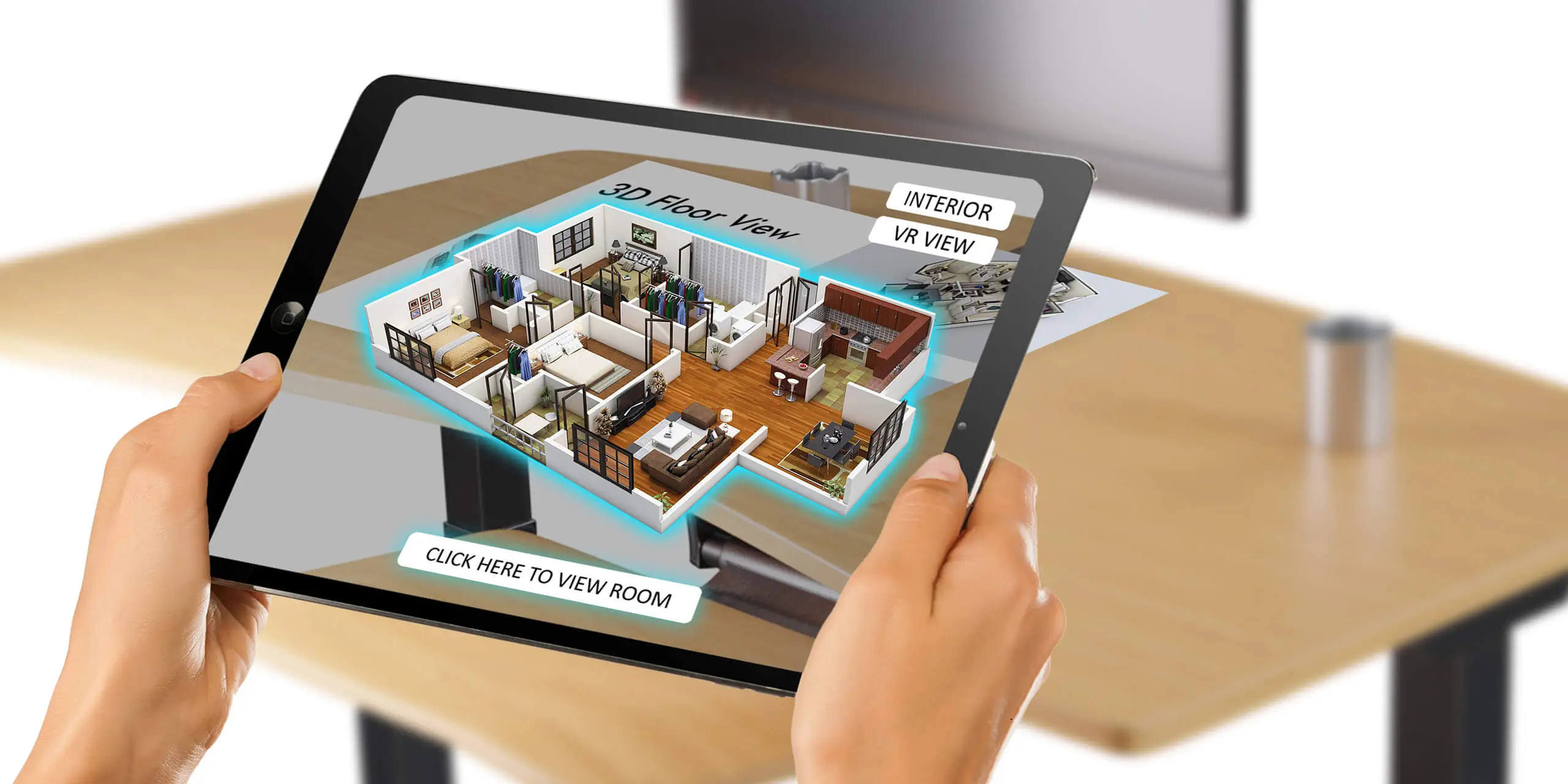
If VR lets the buyer step inside a digital version of a property, AR real estate takes it a step further by blending digital elements with the real world. AR overlays digital objects on the real environment through a smartphone or tablet. For a market dominated by off-plan launches, AR helps buyers visualise finish packages, furniture placement, colour schemes, lighting choices, and small layout adjustments—all without needing physical mock-ups.
How AR Works
- The device maps room dimensions
- Buyers choose finish/material options
- The system overlays digital objects aligned with real geometry
- They can toggle between layout and furniture sets
AR is particularly useful for:
- Comparing interior design packages
- Previewing furniture fit in compact apartments
- Understanding ceiling height and lighting ambience
- Switching between “standard” and “premium” upgrades
Real-World UAE Examples
- Aldar offers AR-driven design selection for some communities.
- Emaar has used AR for kitchen/bathroom options during handover phases.
- Boutique developers in JVC, Al Furjan, and Meydan also use AR catalogues for finish selection.
UAE Case Studies
Dubai Hills Launch (Emaar)
During select Dubai Hills estate launches, VR mock-ups allowed overseas leads to explore units remotely through partner agencies. According to publicly available interviews with Emaar’s digital experience team, VR support increased engagement from international buyers who otherwise would have waited for physical tours. (Source)
Saadiyat Grove (Aldar)
Aldar showcased full-scale masterplan visualisations in VR, enabling buyers to walk through planned cultural districts and retail spaces. Sales staff shared in regional press interviews that remote buyers “felt more connected to the project” after exploring VR amenity zones.
Matterport Digital Twins (Dubai Brokerages)
In Matterport’s GCC case, Dubai brokers reported that digital twins helped shorten early viewing cycles for ready properties by letting overseas clients conduct a first “high-clarity virtual visit” before sending a representative or travelling.
Benefits of VR/AR for UAE Buyers & Investors
1. Better Access for Overseas Buyers
Buyers from India, the UK, Russia, China, and the GCC frequently shortlist through online portals. VR helps them understand layouts, views, and spatial character without flying in for a first screening.
A Dubai-based agent quoted in Gulf News described VR as a “sieve for unserious leads,” reducing low-intent appointments.
2. Faster, More Confident Decision-Making
Virtual walkthroughs help buyers eliminate unsuitable units early, reducing the number of physical visits required.
3. Higher Transparency
VR minimises misinterpretation by showing:
- Realistic scale
- Actual lighting behaviour
- Furniture fit
- Window and door alignment
This reduces buyer disappointment during physical viewing.
4. Reduced Viewing Time for Brokers
Agents can pre-qualify leads by sharing VR links.
Buyers who proceed to an in-person visit are usually higher intent.
5. Better ROI for Developers
VR/AR reduces reliance on:
- Multiple show units
- Expensive physical staging
- Large-format brochures
Why VR/AR Matters for Off-Plan Sales in the UAE
Off-plan projects form a major component of new supply in Dubai and Abu Dhabi. Buyers often commit before construction, making VR/AR invaluable.
1. Visualising Homes Before They Exist
VR gives buyers the ability to:
- Walk through units
- Experience higher/lower floors
- Evaluate daylight direction
- Understand balcony size and usable space
2. Understanding Layouts & Proportions
VR solves challenges like:
- Furniture layout uncertainty
- Corridor width perception
- Ceiling height impact
- Room proportion clarity
These are especially relevant in compact and mid-market apartments.
3. AR for Finishes and Customisation
Buyers can compare:
- Material palettes
- Tile patterns
- Cabinetry colours
- Fitted furniture
4. Increased Conversion Potential
Interviews with UAE brokers show that immersive tools increase early buyer trust—particularly among first-time overseas buyers assessing multiple developers.
Many remote investors use VR tours before placing bookings or paying initial instalments.
Challenges & Limitations of VR/AR Real Estate
1. Initial Production Costs
Creating detailed VR models can be costly, especially for large masterplans. Small developers often adopt VR gradually.
2. Architectural Revisions
Off-plan drawings frequently evolve. VR assets must be updated to stay accurate.
3. Hardware Variability
Buyers viewing on older smartphones may experience less fidelity.
Showrooms still rely on high-end GPU hardware.
4. Bandwidth Requirements
Large VR files may load slowly for overseas buyers using lower-speed networks.
5. Sales Team Learning Curve
Sales teams must integrate VR naturally into their pitch flow. Some developers pair VR sessions with guided commentary to ensure consistent messaging.
Outlook: VR/AR + AI + Metaverse in UAE Real Estate
1. AI-Personalised Virtual Tours
AI tools are emerging that can:
- Predict buyer preferences
- Filter recommended layouts
- Highlight relevant units within a community
This reduces browsing friction.
2. Digital Twins for Communities
Digital twins simulate:
- Transport patterns
- Amenity usage
- Daylight paths
- Environmental factors
The Dubai Municipality is creating a digital twin of the entire city (called “Dubai Here“). It maps underground pipes, buildings, and landmarks to help plan future developments.
3. VR-Enabled Transaction Steps
Future VR platforms may integrate:
- Document review
- Interactive handover inspections
- Digital signature components
Regulatory frameworks will determine speed of adoption.
4. AR-Powered Interior Design
Buyers may preview lighting scenes, furniture sets, and custom interior upgrades. AR may also connect with furniture retailers in the region.
5. Metaverse Communities
Developers globally have experimented with metaverse-linked real estate. Adoption in the UAE will depend on regulation, practical utility, and buyer behaviour—not hype alone.
AI doesn’t just generate tours; it can also handle incoming calls just like a professional property advisor.
Conclusion
VR and AR are transforming the UAE property buying experience. As the region’s real estate market continues to attract international demand, immersive technologies offer buyers more clarity and developers more efficient ways to communicate value.
These tools reduce uncertainty, improve transparency, and accelerate the off-plan decision cycle. As VR/AR merges with AI, digital twins, and smart-city planning, immersive buying is likely to become a standard part of the UAE’s real estate journey.
Eumentis AI supports UAE developers and brokerages in evaluating VR/AR adoption, aligning digital workflows, and improving buyer experience.


