
How AI Interview Agents Are Changing Technical Hiring Practices Today

Software hiring has become harder to assess accurately. A CV can show technologies, experience and previous employers, but it cannot reliably show how a candidate approaches a problem, debugs code, explains technical decisions or works through an unfamiliar situation.
Recruiters and engineering teams are also dealing with higher application volumes and increasingly AI assisted applications. LinkedIn’s 2026 research found that 66% of recruiters say finding qualified talent has become harder, while 66% plan to increase their use of AI for pre screening interviews. The research covered markets including the UK and India.
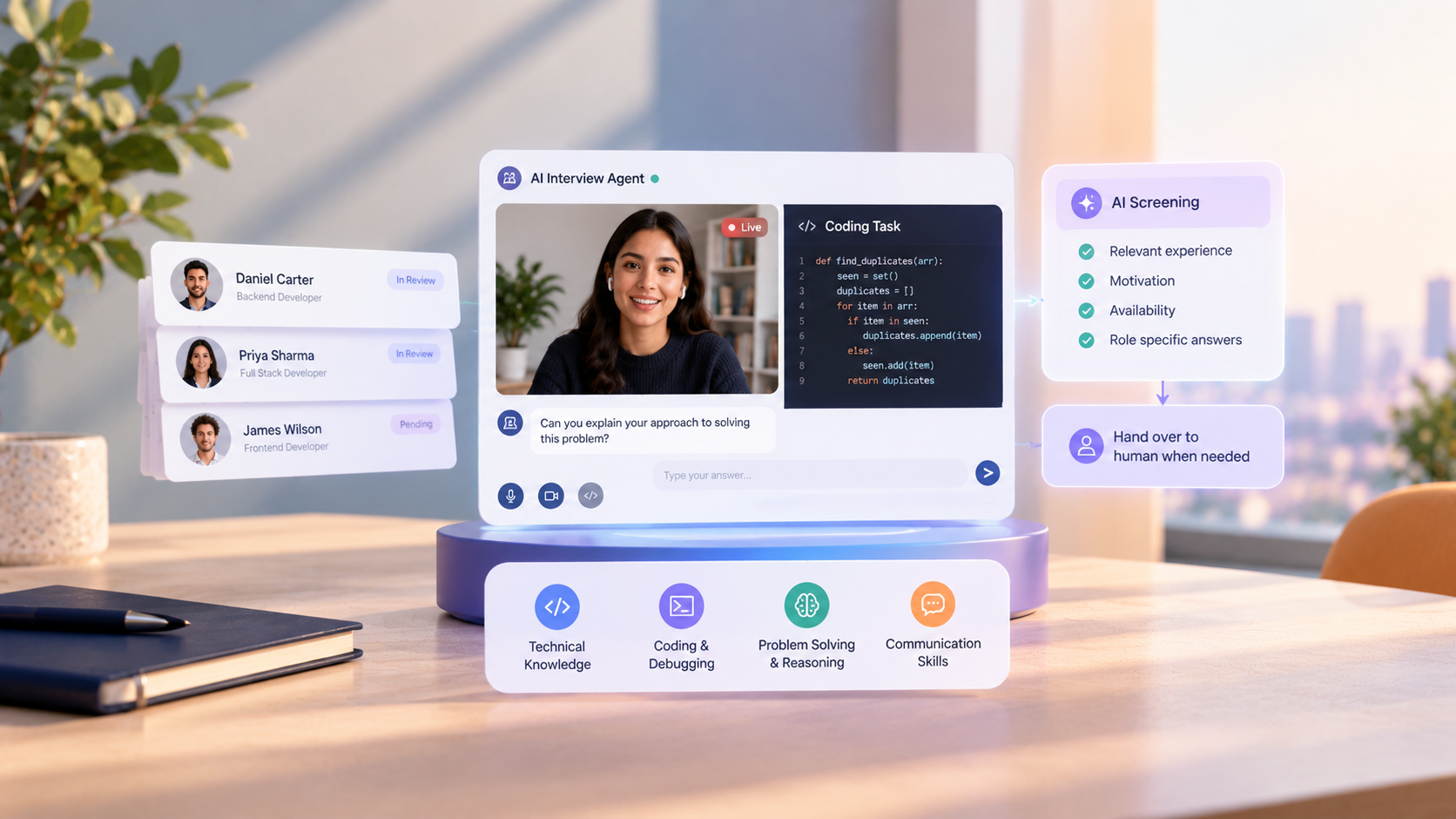
This is where AI interview agents are becoming relevant. They can conduct initial conversations, ask role specific technical questions, evaluate coding tasks and generate structured evidence for the hiring team.
The question is which parts of technical interviewing can be handled consistently by an AI interview agent, and where human judgement should remain.
What Is an AI Interview Agent?
An AI interview agent is software that can conduct an interview conversation with a candidate, ask questions based on the role, respond to answers and assess predefined criteria.
Unlike a static questionnaire, an agent can make the conversation interactive. If a candidate gives an incomplete answer, it can ask a follow up question. If a candidate explains a technical solution, it can explore the reasoning behind it rather than simply recording a yes or no response. For technical hiring, this can cover coding, debugging, problem solving, system design, technology knowledge and communication.
The exact capabilities depend on the assessment design. An AI interview agent should not simply generate questions and produce a score; the questions, criteria and evidence must be relevant to the role.
This aligns with structured interview practice. The UK CIPD recommends assessing candidates against consistent criteria, while the US Office of Personnel Management recommends job related competencies, standardised questions and defined scoring criteria.
Why Technical Hiring Needs More Than CV Screening
Software development is a practical discipline. A candidate may list Python, Java, React, AWS or SQL on a CV, but that does not necessarily demonstrate how well they can use those technologies.
A technical interview can investigate the difference.
Instead of asking, “Do you have experience with Python?”, an AI interview agent could present a short coding problem and ask the candidate to explain their approach before writing the solution. It could then explore why they selected that approach, ask how they would handle an edge case or present a debugging scenario.
This matters as AI becomes part of everyday software development. Stack Overflow’s 2026 Developer Survey reports that 83% of respondents use at least one AI tool, with coding assistants and coding agents the dominant AI use case.
Technical hiring therefore has to assess more than whether someone can write code from scratch. It increasingly needs to examine whether they can understand, evaluate, debug, improve and make decisions around code.
How AI Interview Agents Can Conduct Technical Interviews
A well designed AI interview agent can move through several stages of a technical assessment.
Technical knowledge
The agent can ask questions related to the technologies and competencies required for the role. For a backend developer, that might include APIs, databases, authentication or system architecture. For a frontend role, it could explore JavaScript, React, browser behaviour or performance.
Coding and practical assessment
The candidate can be given a coding problem within an assessment environment. The evaluation does not have to stop at whether the code runs; it can examine the approach, reasoning, debugging process and explanation.
Follow up questions
If a candidate chooses a particular algorithm, the agent can ask why. If the solution is inefficient, it can ask how they would improve it.
Problem solving and reasoning
Technical ability is not only about syntax. An AI interview agent can present a scenario and ask the candidate to break the problem down, identify assumptions, explain trade offs and decide what they would investigate first.
This gives the hiring team evidence about how the candidate thinks, rather than only whether they selected the correct answer.
AI Interview Agents vs Traditional Technical Interviews
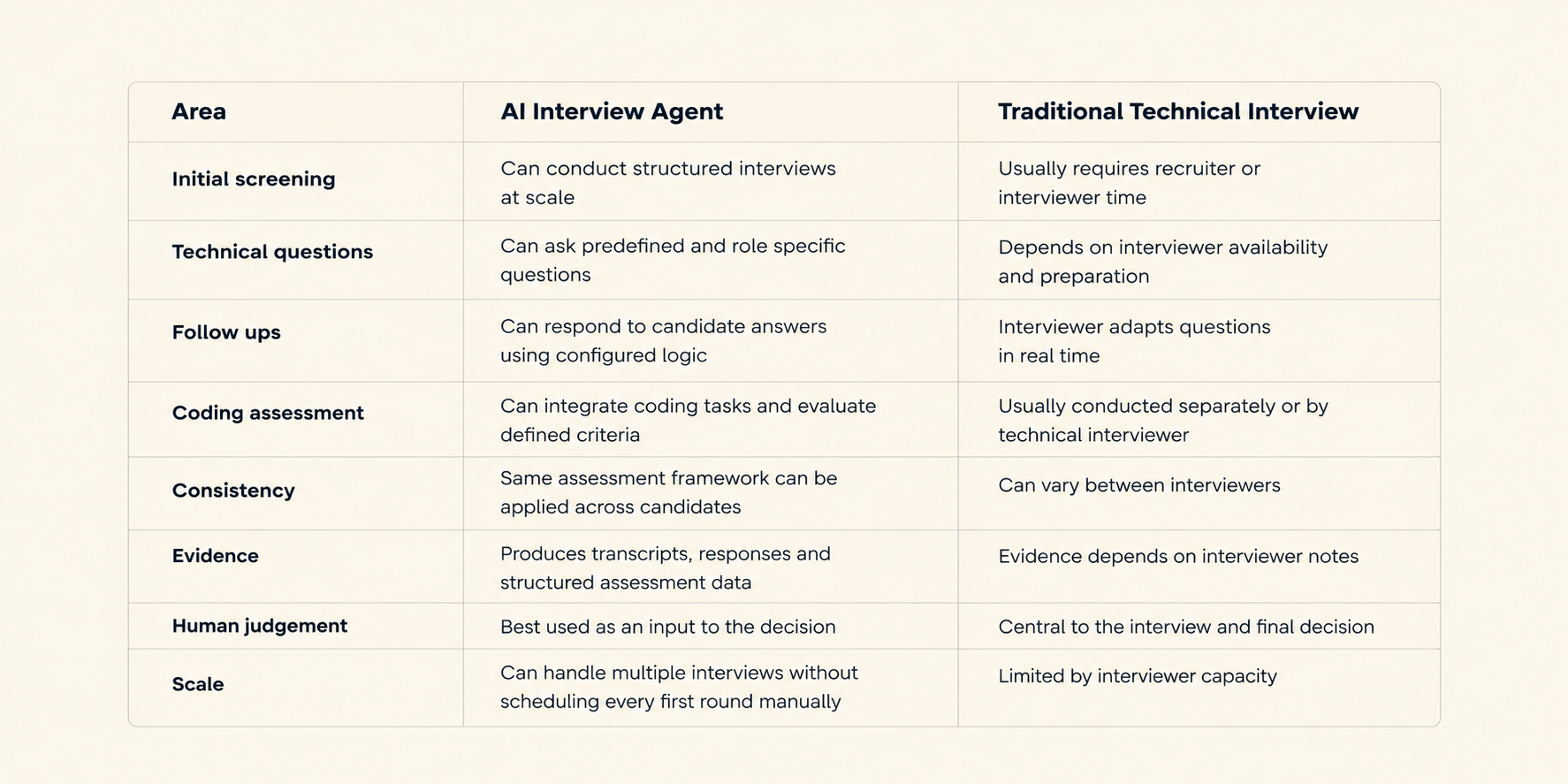
AI interview agents are strongest when they expand assessment capacity rather than replace technical judgement.
AI Interview Agents Are Already Moving Into Technical Hiring
This is no longer only a theoretical use case.
HackerRank has documented an AI interviewer for technical screening that considers more than whether submitted code compiles, including signals such as problem decomposition and engineering reasoning. HackerRank has also introduced an AI native interview environment in which candidates can work with AI during software engineering assessments. Technical assessments can therefore examine how candidates use, verify and evaluate AI generated code.
Eightfold has introduced an AI agent based interview approach combining screening, role fit and coding while keeping the human decision maker involved.
These examples suggest that technical interviewing is moving towards evidence based assessment of how candidates solve problems.
What Changes for UK and Indian Hiring Teams?
The opportunity is particularly relevant to organisations hiring at scale across markets such as the UK and India.
For UK employers, responsible implementation matters as much as efficiency. The UK Information Commissioner’s Office says organisations using automated recruitment decisions need safeguards around transparency, fairness, bias and data protection. Candidates should know when automation is used and have routes to challenge a decision and request human review.
The UK Government’s Responsible AI in Recruitment guidance highlights benefits such as efficiency, scalability and consistency while warning about risks including bias and digital exclusion.
For Indian organisations and recruitment firms, the same operational principle is useful: AI can handle structured, repeatable parts of candidate assessment, but hiring teams should define what the system is assessing, monitor outcomes and keep appropriate human oversight.
This is valuable when recruiting software engineers across large candidate pools, where individual first round interviews can quickly consume recruiter and engineering time.
Where Human Interviewers Still Matter
AI interview agents should not be the final authority on whether someone deserves a job.
Technical hiring involves context that automated systems may not fully understand. A candidate may have an unconventional career path, explain a solution differently from the expected approach or demonstrate strengths that are difficult to capture through a predefined assessment.
The strongest model is therefore a human plus AI workflow. The AI interview agent can handle the repeatable assessment layer by conducting the initial conversation, asking technical questions, running structured exercises and organising evidence.
The recruiter or technical interviewer can then focus on candidates who have demonstrated relevant ability. This also fits the direction of UK regulatory thinking, where meaningful human involvement remains important when automated systems influence recruitment decisions.
Where AI Interview Agents Fit Into the Hiring Process
A practical workflow could look like this:
Application → CV screening → AI interview agent → coding or technical assessment → recruiter review → human technical interview → final decision
The AI interview does not have to become another isolated hiring tool. It can become the assessment layer between application screening and deeper human interviews.
For example, a software recruitment agency could receive hundreds of applications for a developer role. Instead of manually repeating the same first round, an AI interview agent could conduct an initial technical conversation and coding assessment based on the role requirements.
The recruiter then reviews the structured information and decides who should progress.
What Recruiters Should Look For in an AI Interview Agent
Not every AI interviewer is suitable for technical hiring.
Before adopting one, recruitment teams should evaluate whether it can assess skills relevant to the job, ask meaningful follow up questions, support coding or practical assessments, explain how scores are generated, produce assessment evidence, apply consistent criteria, support human review, provide candidate transparency, integrate with the recruitment workflow and monitor assessment quality and potential bias.
The objective should not be to automate hiring for the sake of automation. The objective should be to collect better evidence before valuable human interview time is spent.
How Eumentis AI Fits Into the Future of Technical Hiring
Eumentis AI helps recruitment teams automate repetitive candidate conversations such as screening, availability checks, interview scheduling and follow ups. For high volume hiring, AI interview agents can extend this workflow into structured technical screening, helping teams collect useful candidate evidence before a human interview. The goal is not to replace recruiters or technical interviewers, but to reduce repetitive assessment work so they can focus on deeper technical judgement, role fit and the final hiring decision.


