
How Artificial Intelligence Can Help Recruiters Screen Unviable Candidates


Recruiters are spending valuable time talking to candidates who were unlikely to progress in the first place.
As application volumes rise, teams are dealing with more poor quality applications, highly similar CVs and increasingly polished applications that can make basic screening harder. Generative AI has also made it easier for candidates to tailor applications to specific job descriptions, making it more difficult to judge how accurately a CV reflects the candidate’s actual capabilities. Eploy’s 2026 UK Candidate Attraction Report found that 28% of recruiters now consider candidate use of AI in applications a recruitment challenge, highlighting the growing difficulty of assessing the person behind the application.
The result is a costly screening dilemma. Recruiters either spend hours speaking to candidates who do not meet the role requirements, or rely heavily on ATS and CV filters and risk overlooking someone who could have been a strong fit. The problem is not simply identifying more candidates; it is identifying which candidates are worth a recruiter’s time before that conversation happens. This is where AI candidate screening can add value by handling the repetitive first layer of assessment and gathering more relevant information before a recruiter steps in.
Why candidate screening is becoming a bigger recruitment problem
The first stage of recruitment is supposed to narrow the pool. In practice, it can become the most time consuming part of the process.
Recruiters may have to review hundreds of applications, identify obvious mismatches, contact suitable candidates, confirm their availability, ask basic screening questions and follow up with people who have not responded. When the same process is repeated for every vacancy, the recruiter spends a significant amount of time establishing information that is often relatively straightforward to collect.
The quality of the applications can make the problem worse. A role can attract CVs that use almost identical phrases such as “excellent communication skills,” “team player,” “results driven” and “strong problem solving abilities.” These phrases may sound relevant, but they do very little to distinguish one candidate from another.
AI has added another layer to this problem. According to the Institute of Student Employers’ 2026 Development Survey, 67% of employers are concerned that graduates may misrepresent their abilities through AI use during selection, up from around half in 2025. The equivalent figure for school and college leavers is 66%.
The problem, therefore, is not simply more applications.It is that written applications are becoming less useful as the only signal of candidate capability.
Why CV Screening Alone Is No Longer Enough
There is no need to get rid of the CV. It still gives recruiters valuable information about a candidate’s career history, qualifications, previous responsibilities and experience. The mistake is treating that information as enough to determine who deserves a conversation.
A CV might tell you that a candidate has worked in sales for five years. It will not tell you how they handle a difficult prospect. It might say that a customer service candidate performs well under pressure. It will not show how they respond when a customer becomes frustrated. It might show relevant industry experience. It will not necessarily tell you whether the candidate understands the role, is genuinely motivated to take it, or can communicate effectively when asked an unexpected question.
This matters because what happens after hiring depends on more than whether a candidate looked suitable on paper. The closer the screening process gets to the capabilities required in the actual role, the more useful the information becomes.
Research into structured interviews supports this approach. The US Office of Personnel Management notes that structured interviews can assess job related competencies and that performance in structured interviews is related to performance on the job. OPM guidance on structured interviews
The practical lesson is important for recruiters: screening should move from what the candidate has written towards what the candidate can demonstrate.
The two screening mistakes recruiters are trying to avoid
Every recruitment team wants to remove unsuitable candidates from the process. But filtering has to solve two problems at once.
The first is false progression. A candidate looks good on paper, passes an ATS filter and reaches a recruiter, only for the first conversation to reveal that their experience is not relevant, their expectations do not match the role or they are not genuinely interested.
The second is false rejection. A candidate is removed because their CV does not match the expected terminology or format, despite having experience that could have made them a strong candidate.
A useful screening process has to reduce both.
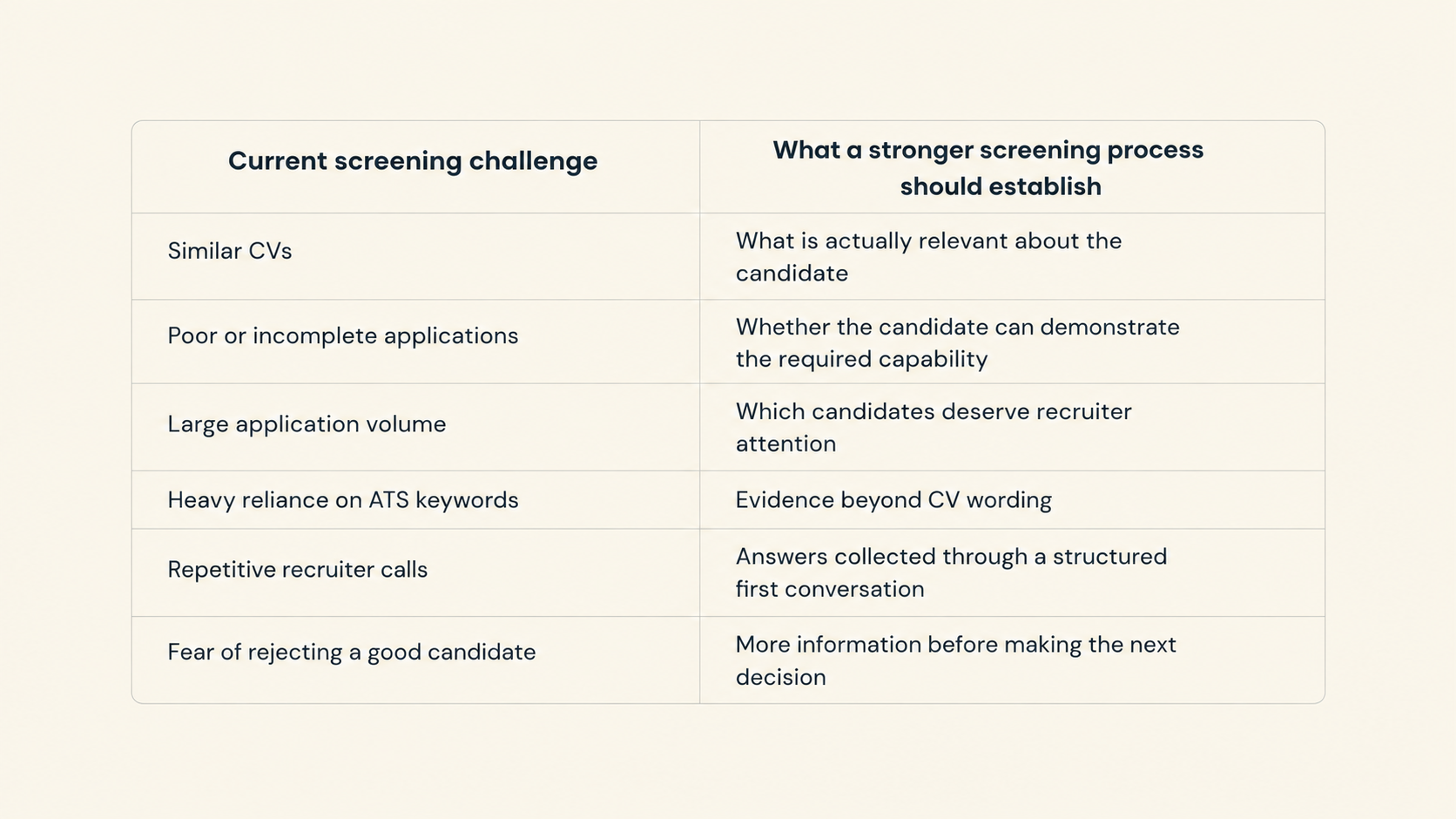
A candidate conversation can reveal information a CV cannot
This is where conversational AI becomes particularly valuable.
Instead of using AI only to scan a CV for keywords, recruiters can use an AI agent to have an initial conversation with candidates. The purpose is not to conduct the final interview or decide who gets hired. The purpose is to collect meaningful information before the recruiter invests more time.
The screening conversation can be built around the actual requirements of the vacancy.
For example, the agent can explore:
Relevant experience: whether the candidate has worked in a comparable environment and what responsibilities they actually handled.
Motivation: why they are interested in the position and whether the role aligns with what they are looking for.
Availability: notice period, location, working arrangements and other practical requirements.
Role related situations: how they have handled a difficult customer, competing priorities, pressure or an unexpected problem.
Communication: whether they can explain their experience clearly rather than simply presenting polished statements in a CV.
For sales recruitment, the conversation can go further. A candidate can be given a short mock sales call and asked to respond to a prospect who raises an objection. That gives a recruiter information that the phrase “strong communication and negotiation skills” never could.
The important principle is that the screening should reflect the role. A generic AI interview asking every candidate the same broad questions is not automatically better recruitment. A structured conversation designed around the competencies needed for a particular vacancy is far more useful. OPM’s guidance on selecting competencies for structured interviews provides a strong framework for this kind of role specific assessment.
Where AI adds the most value in recruitment
The biggest advantage of AI candidate screening is not that it can read a larger number of CVs.
It is that it can take the repetitive first conversation out of the recruiter’s workload.
A recruiter does not need to personally ask hundreds of candidates whether they are interested in the position. They do not need to repeat the same questions about experience and availability throughout the day. They do not need to chase every candidate for a response or manually coordinate every early stage interview.
AI can handle those structured interactions at scale while the recruiter reviews the information that comes back.
This creates a more practical recruitment workflow:
Application → initial screening → candidate conversation → recruiter review → human interview → hiring decision
The recruiter remains involved, but at a more valuable point in the process. Instead of spending the first conversation finding out whether the candidate meets the basic requirements, the recruiter can spend that time understanding whether the candidate is actually worth progressing.
LinkedIn’s 2026 research shows that this direction is already becoming mainstream. 66% of recruiters said they plan to increase their use of AI for pre screening interviews in 2026, while 70% believe it will help them have more valuable conversations with candidates.
That is a much stronger reason to adopt AI than automation for its own sake.
Human judgement becomes more important after AI does the first filter
AI candidate screening should not be positioned as a system that decides who is a good hire.
Recruitment involves context that cannot always be reduced to a score. A recruiter may recognise potential in an unconventional career path. They may understand why someone changed industries. They may pick up on something in a conversation that requires a deeper question. A hiring manager may see a capability that was not obvious during the first screening stage.
That is where human intuition matters. The role of AI is to make sure the recruiter has more useful information before using that intuition.
This distinction is also important when implementing AI responsibly. The Information Commissioner’s Office has identified recruitment as a key area of focus and has warned organisations about the risks of unfair or insufficiently supervised automated decisions. Its 2026 work with more than 30 employers highlighted the importance of meaningful human involvement, transparency and monitoring for bias when automation is used in recruitment.
This reinforces a sensible model for recruiters: AI should filter and gather evidence. Humans should interpret that evidence and make the important decisions.
A smarter screening process gives recruiters more time for the candidates who matter
Consider the difference between these two recruitment processes.
In the traditional approach, a recruiter reviews a large pool of CVs, selects candidates, contacts them one by one, asks the same basic questions, checks availability and then decides who should receive a more detailed interview.
In an AI supported process, the repetitive first layer happens through a structured candidate conversation. The recruiter then receives information about relevant experience, motivation, availability and responses to role specific questions before deciding who deserves further human assessment.
The difference is not simply time saved. It is where the recruiter spends that time.
A recruiter should be using their expertise to assess candidates, advise clients, build relationships and make hiring decisions. Spending hours talking to candidates who clearly do not meet the requirements adds little value to that work.
The aim should therefore be to reduce unnecessary conversations while giving suitable candidates a better opportunity to demonstrate what they can actually do.
How Eumentis AI supports recruiter screening
Eumentis AI can act as the conversational layer between the application and the recruiter.
Its AI recruitment agent can speak with candidates, conduct initial screening conversations, ask predefined role specific questions, understand responses, capture relevant information such as experience and availability, support interview scheduling and manage candidate follow ups. Eumentis has also outlined how an AI recruitment agent can fit into an existing recruitment workflow without requiring recruiters to hand over the entire hiring process.
The value comes from using that capability for the part of recruitment that is repetitive and scalable.
A candidate can be contacted, screened and asked relevant questions without the recruiter having to repeat the same conversation for every application. The recruiter can then step in when the candidate has reached the point where human judgement adds the most value.
For recruitment agencies handling large candidate pools, this creates a more efficient division of work: AI handles the volume and repetitive screening, while recruiters focus on assessment, relationships and decisions.
The goal is not to replace CVs, recruiters or human intuition. It is to stop using recruiter time to determine basic suitability when a conversational AI agent can handle that first layer.


