
WhatsApp for Estate Agents: A Guide to Property Leads and Follow-Ups

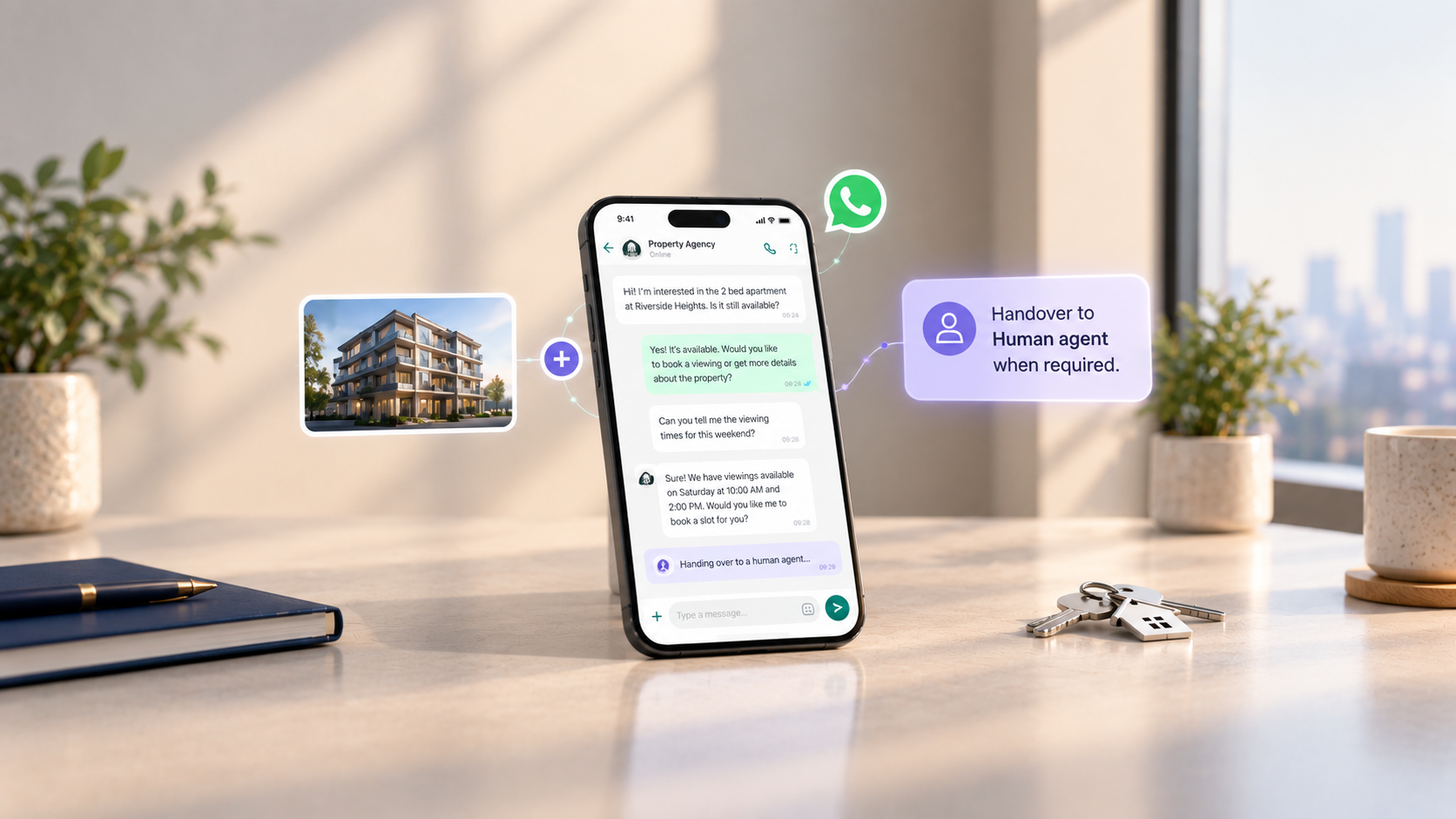
A property enquiry does not always need a phone call. Some buyers want a quick answer, some would rather read property details than speak to an agent, and others simply make enquiries outside office hours. For those prospects, WhatsApp can be a practical way to keep the conversation moving without forcing every interaction into a call or email.
But adding WhatsApp to an estate agency is not the same as having a WhatsApp number. The real challenge is deciding when to use it, what should happen inside the conversation, and how to make sure important follow-ups do not get lost.
Recent Zoopla research found that communication preferences among UK sellers vary, while speed remains important: 67% expected a response from an estate agent within four hours and 26% expected one within an hour. Phone and email remained the most commonly preferred channels, which is a useful reminder that WhatsApp should complement an agency's communication strategy rather than replace it.
Choosing the Right Channel for Property Lead Conversations
The simplest way to decide is to look at the conversation itself. A phone call is often better when an agent needs to understand a buyer's requirements, discuss a property in detail or have a more personal conversation. Email works well when the information is longer, formal or needs to be kept for reference.
WhatsApp is useful in the space between the two. A buyer can ask whether a property is still available, request a brochure, ask about viewing times, share their requirements or confirm an appointment without having to start a phone call. That makes it particularly useful for quick, two-way property conversations.
The best estate agencies therefore do not ask, “Should we use WhatsApp instead of calls?” They ask, “Which channel makes this particular conversation easiest for the customer?”
From Property Enquiry to Conversation
A property lead usually starts with very little context: a name, phone number and the property they have viewed. WhatsApp can help turn that basic enquiry into a useful conversation. An initial response can answer the immediate question and then move naturally into the next step: whether the buyer is still interested, what they are looking for, whether they want to arrange a viewing or whether another property may be more suitable.
This is where WhatsApp for property leads becomes more than another messaging channel. Used properly, it becomes part of the qualification and follow-up process.
For example, a buyer might ask about a two-bedroom flat. Rather than sending a generic response, the conversation can establish whether they are looking to buy or rent, their preferred area, approximate budget and whether they would like to arrange a viewing. That information gives the agent useful context before the next human conversation. It also creates a more natural route for people who do not want to call or do not have time for a phone conversation.
WhatsApp Should Not Become Another Inbox
This is where estate agencies can run into trouble. One agent replies from a personal phone. Another follows up later. A viewing is agreed in a chat but never added to the CRM. Someone asks for the same property details again because the previous conversation cannot be found.
The problem is not WhatsApp. It is the lack of a defined workflow around WhatsApp. A good process should make three things clear: who owns the conversation, what needs to happen next and where the interaction is recorded.
That becomes even more important when an agency already handles leads from property portals, its website, email and phone. A CRM should bring those interactions together so an agent can see where a lead came from, what has already been discussed and what needs attention next. That is also why CRM selection matters in the wider property-lead workflow. Eumentis' guide on choosing a CRM for a real estate business looks at communication history, follow-up, integrations and visibility as part of the same process.
Speed, Context and the Next Step
For property enquiries, the value of WhatsApp is not simply that messages are convenient. It can reduce the gap between someone showing interest and an agent being able to act on it. Zoopla's 2025 research found that 67% of surveyed UK sellers expected a response from an estate agent within four hours, while 26% expected one within an hour. Rightmove's 2025 research similarly found that 97% of surveyed homeowners considered responsiveness essential or very important when choosing an agent.
That makes the first WhatsApp conversation more important than the number of messages an agency sends. A useful response should answer the enquiry, capture just enough information to understand the prospect's intent and make the next step easy - whether that is sharing property details, qualifying the requirement, arranging a viewing or bringing an agent into the conversation. The objective is not more WhatsApp follow-ups; it is moving a genuine property enquiry closer to a meaningful next step.
Where Automation Fits
The next step is not to automate every WhatsApp conversation. It is to identify the parts that are repetitive enough to handle automatically.
For example, a conversational AI agent can respond when a prospect first reaches out, provide basic property information, ask qualifying questions and help with routine viewing requests. If the conversation becomes more specific or requires judgement, it can be passed to a human agent with the relevant context.
That human handoff is important. A buyer may be happy to ask an AI about property availability or viewing times but prefer to speak with an agent when discussing something more personal, complicated or decision-critical.
The transition also does not necessarily need to happen only when the customer explicitly asks for a person. A well-designed system can recognise when a conversation has moved beyond the scope of routine information and bring an agent in at the right point. This creates a more useful model of WhatsApp automation for estate agents: AI keeps straightforward conversations moving, while people step in where their judgement adds value.
What About WhatsApp Marketing?
There is an important difference between responding to an enquiry and sending marketing messages.
If someone contacts an agency asking about a property, the agency can respond to that conversation. But sending unsolicited promotional WhatsApp messages is subject to UK direct-marketing rules.
The ICO treats texts, direct messages and other electronically stored messages as electronic mail for PECR purposes. For direct marketing to individual subscribers, organisations generally need consent unless a specific exception such as the soft opt-in applies. The rules also require businesses to identify themselves and provide a way for people to opt out.
For estate agencies, that means a WhatsApp strategy should distinguish between service conversations, enquiry responses and marketing campaigns rather than treating every contact as someone who can automatically receive property promotions.
A Better Way to Think About WhatsApp for Estate Agents
WhatsApp is most useful when it removes friction from an existing customer journey.
A prospect sees a property and wants an answer. They open WhatsApp instead of making a call. The conversation captures what they need, answers the straightforward questions and, where appropriate, moves towards a viewing or a conversation with an agent.
That is a very different proposition from simply adding a “Message us on WhatsApp” button to a website. The channel works best when it is connected to lead qualification, follow-up, scheduling and human handoff - with the conversation and its context staying visible to the team.
Final Verdict
WhatsApp can be a practical channel for estate agents to handle property enquiries, share information, qualify interest and keep conversations moving. Its value increases when it is connected to the wider lead workflow rather than managed as a separate inbox.
Eumentis AI enables estate agencies to use WhatsApp as a conversational channel for property enquiries. Its AI can answer routine questions, collect relevant property requirements, continue follow-ups and help move interested prospects towards actions such as viewing requests. When a conversation needs human judgement, it can be handed over to the agent with the context already captured, keeping the transition between AI and the team seamless.
This approach allows agencies to use WhatsApp for faster, more structured lead communication while keeping human agents involved where their input matters most.


