
AML Compliance for Estate Agents: A Practical HMRC Guide for 2026


An estate agent can verify a client's identity, collect a bank statement and still have an incomplete AML process.
That is because anti-money laundering compliance for estate agents goes far beyond checking someone's ID. HMRC expects estate agency businesses to understand the risks around their customers and transactions, apply the right level of customer due diligence, monitor the relationship and be able to show why decisions were made.
The timing matters too. HMRC published its new Anti-Money Laundering Guidance for Supervised Businesses on 8 July 2026 and updated it on 16 July, incorporating changes to the Money Laundering Regulations that came into force on 30 June 2026. Its estate-agent risk assessment also makes clear that property remains a higher-risk sector for money laundering, with estate agents identified as one of the property sectors with the highest exposure. HMRC cites the 2025 National Risk Assessment and an NCA estimate that up to £10 billion could be laundered through the UK property market each year.
So what does AML compliance for estate agents actually require in 2026?
Who Needs to Register for AML Supervision?
If a business carries out estate agency work covered by the Money Laundering Regulations, it needs to comply with the AML framework. HMRC's current estate-agent guidance covers activities such as buying and selling property, arranging viewings, providing property details, advising buyers or sellers, acting as an intermediary and property sourcing or deal packaging.
Estate agency businesses must apply for HMRC money laundering supervision before trading. Current HMRC guidance also says an estate agency business can trade once it has applied for registration, while the application is being processed.
This is not just an administrative formality. HMRC's latest published enforcement list includes estate agency businesses penalised for trading without registering, as well as failures involving policies, training and customer due diligence.
Check whether your estate agency needs to register with HMRC
What Does HMRC Expect an Estate Agency to Have in Place?
Registration is only the starting point. A compliant estate agency needs a framework that connects its risk assessment with what staff actually do.
At a minimum, that means having:
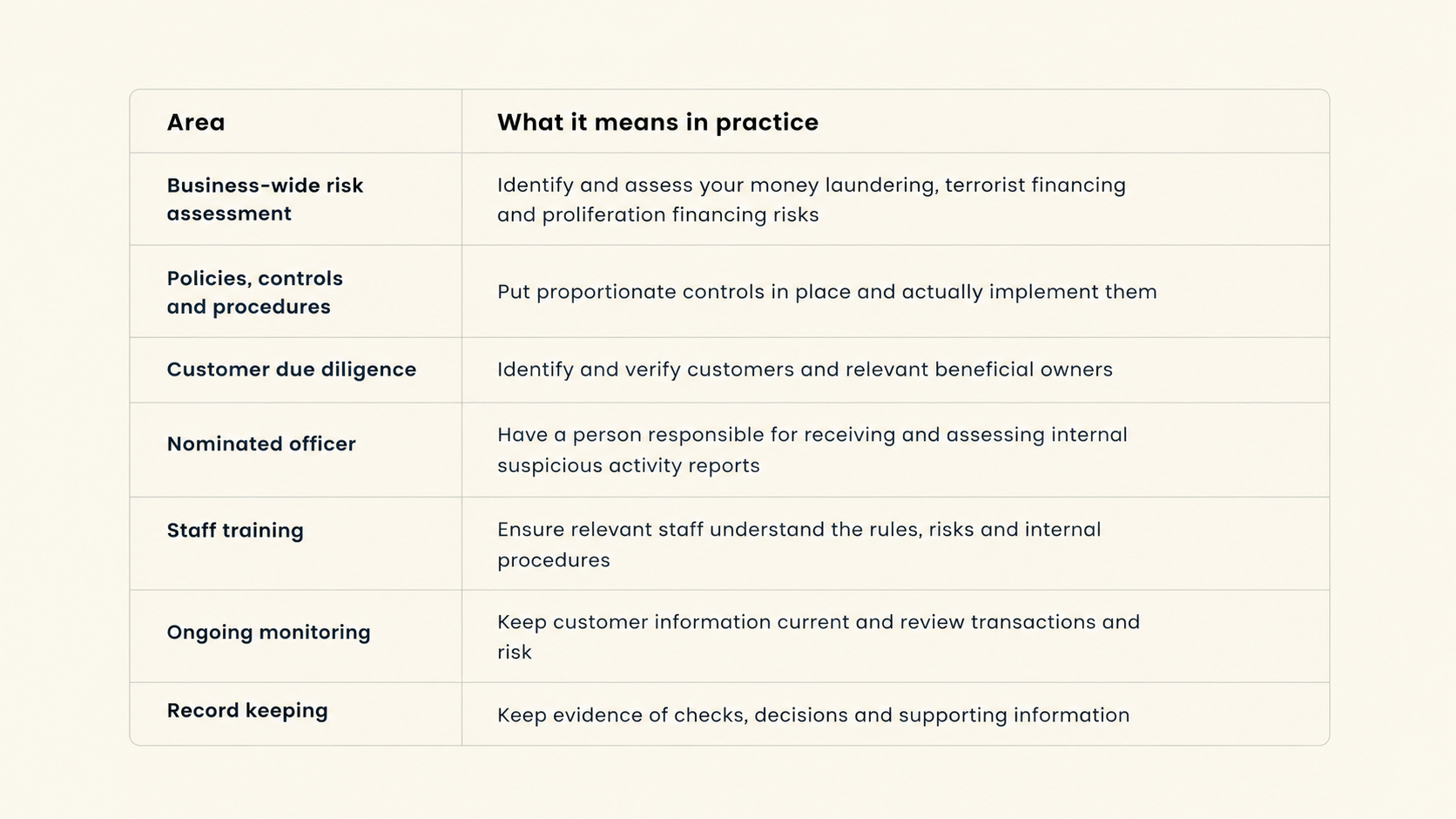
HMRC says the business-wide risk assessment must inform its policies, controls and procedures, and expects those procedures to be actively implemented rather than simply kept in a folder. It also expects risk assessments to be reviewed at least annually and when relevant changes occur, such as a new service, jurisdiction, technology, branch or customer profile.
For larger or more complex businesses, HMRC expects additional controls, including appropriate compliance oversight and independent auditing arrangements.
What Are the Main AML Checks for Estate Agents?
The exact level of checking should be risk-based, but customer due diligence is broader than simply confirming a person's name and address.
HMRC describes CDD as the checks businesses carry out on customers and, where applicable, beneficial owners. Depending on the circumstances, this can involve understanding ownership and control, the purpose and intended nature of the relationship, ongoing monitoring and the origin of funds.
For an estate agency, that can include:
Identity and verification: establishing who the buyer or seller actually is.
Beneficial ownership: understanding who ultimately owns or controls a company, trust or other legal structure where relevant.
PEP and sanctions screening: identifying politically exposed persons and relevant sanctions risks.
Source of funds: understanding where the specific money being used for the property transaction came from.
Source of wealth: where required, understanding how the customer's wider wealth was accumulated.
Enhanced due diligence: applying additional measures where the customer or transaction presents higher risk.
The current HMRC estate-agent guidance is explicit that the relevant customers can include both buyer and seller, as well as intermediaries acting on their behalf.
Proof of Funds Is Not the Same as Source of Funds
This is one of the easiest areas to misunderstand.
A bank statement can show that a buyer has £250,000 available. That is evidence that the funds exist. It does not necessarily explain how those particular funds were obtained.
HMRC defines source of funds as the provenance of the money being used for the transaction. Depending on the circumstances, that could involve savings from employment, proceeds from another property sale, inheritance, investment proceeds or a gift. Source of wealth is broader and relates to how the customer's overall wealth was accumulated.
HMRC's 2026 estate-agent risk assessment also says source of funds must be scrutinised during property transactions as part of ongoing monitoring, and identifies unexplained third-party funding, cash, cryptocurrency, unusual payment patterns and unexpected changes in financial arrangements as risk indicators.
The important point is that collecting a document is not the same as understanding the financial story behind a transaction.
What Are the AML Red Flags Estate Agents Should Notice?
Not every unusual transaction is evidence of money laundering. But unusual behaviour can change the risk assessment and may require further investigation.
HMRC highlights risks including:
- Payments from an unrelated third party
- Cash, cryptocurrency or foreign-currency funding
- Sudden or unexplained changes to the transaction
- Complex company or ownership structures
- Customers or intermediaries linked to higher-risk jurisdictions
- Unusual transaction speed
- Customers being evasive about their identity, ownership or funding
- Funding arrangements that do not make sense in the context of the customer
For example, HMRC says a payment from a bank account not associated with the customer could indicate that an apparently unrelated third party is actually bearing the cost of the transaction. It also flags unexplained late-stage changes and opaque ownership structures as higher-risk indicators.
These are risk indicators, not automatic proof of wrongdoing. The agency still needs to assess the circumstances and decide what further action is appropriate.
When Should Estate Agents Carry Out AML Checks?
Timing matters.
HMRC's current guidance recommends that estate agents start CDD as early as possible. For a buyer, HMRC recommends completing all aspects of CDD as soon as possible after first contact and before an offer is accepted; at the latest, it must be complete by the point the business relationship is established. For sellers, checks should also begin as soon as possible and be complete by the point the business relationship is established.
This is one reason AML should not be treated as a last-minute conveyancing exercise. Leaving checks until a transaction is already moving quickly can create delays precisely when everyone expects the deal to progress.
AML Compliance Doesn't End After the First Check
A customer passing an initial AML check does not mean the file can be forgotten.
HMRC requires ongoing monitoring throughout the business relationship. That includes keeping customer due diligence information up to date, reviewing beneficial ownership where relevant and monitoring transactions so they remain consistent with what the agency knows about the customer and their risk profile. Changes in circumstances, unusual transactions or doubts about previous information can trigger further review.
This matters in property because funding arrangements can change during a transaction. A new third party can appear, the source of the deposit can change or the transaction can take an unexpected direction.
AML is therefore not a one-off checkbox. It is an ongoing process of checking whether the transaction still makes sense.
What Happens When an Agency Can't Complete CDD?
The consequences can be more serious than asking a customer for another document.
HMRC's estate-agent guidance says that where the business is unable to apply the required customer due diligence measures, it must not establish the business relationship or carry out the transaction in the circumstances covered by the rules, must terminate an existing business relationship where required, and must consider whether a Suspicious Activity Report (SAR) needs to be made.
Where staff know, suspect or have reasonable grounds to know or suspect money laundering or terrorist financing, HMRC's guidance requires the information to be reported internally to the nominated officer, who assesses whether a SAR should be submitted to the UK Financial Intelligence Unit at the NCA.
Estate agents also should not assume that another professional involved in the transaction - such as a solicitor, bank or another agent has automatically dealt with their reporting obligations.
How Long Do Estate Agents Need to Keep AML Records?
Record keeping is part of compliance, not an afterthought.
HMRC requires businesses to maintain records of their customer due diligence and supporting information. The general record-keeping requirement is five years from the end of the business relationship or completion of the transaction, depending on the record and circumstances.
For an estate agency, that means being able to show not only what was checked, but also the evidence supporting the check and, where relevant, the reasoning behind decisions.
That matters particularly when an agency uses third-party digital verification providers. HMRC makes clear that using a verification service does not transfer the agency's responsibility for compliance. The agency still has to examine the results and take whatever further action its risk assessment requires.
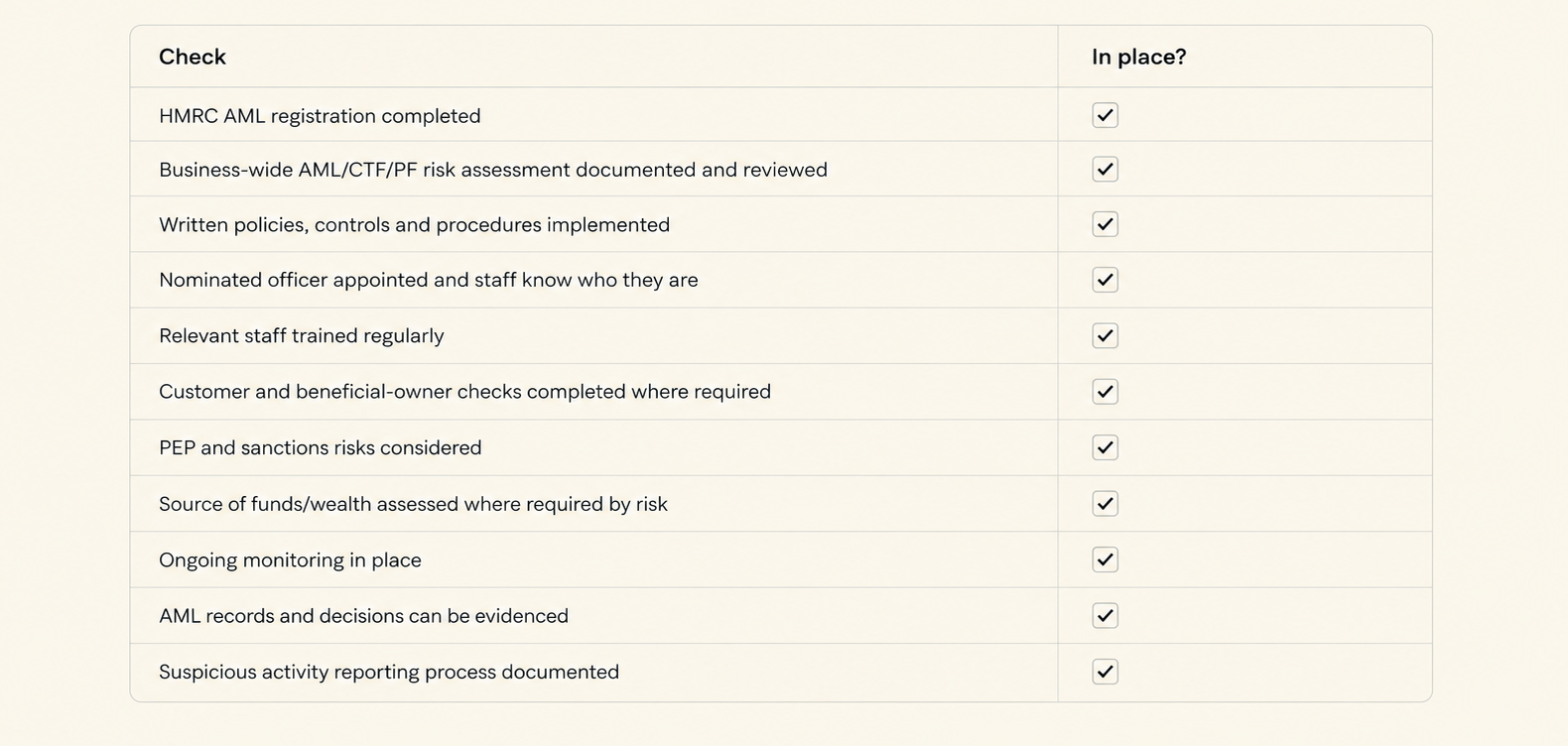
2026 AML Checklist for Estate Agents
Before considering your AML process complete, an agency should be able to answer yes to the following:
Final Verdict
AML compliance for estate agents is much more than identity verification. HMRC's current 2026 framework expects agencies to understand their own risks, apply appropriate due diligence, monitor relationships and keep evidence of what they did and why.
The strongest AML process is therefore not the one with the most checks. It is one that is risk-based, consistently followed and easy to evidence when the agency needs to explain a decision.
For estate agencies reviewing their 2026 procedures, HMRC's current guidance should be treated as the starting point, particularly because the rules and supervisory guidance have recently been updated.
About Eumentis AI
Eumentis AI helps estate agencies streamline the everyday conversations that sit around their core operations. Its conversational AI agents can handle routine enquiries, collect information, follow up with customers and route conversations to the right team member across voice, WhatsApp and website chat. This can reduce repetitive communication and keep teams focused on the work that requires human judgement, while businesses continue to manage compliance processes through their own policies and controls.
This article is for general information and is not a substitute for legal or professional AML advice. Estate agencies should check the latest HMRC guidance and their own obligations before changing their compliance procedures.


