
AI Candidate Screening: How Recruiters Can Automate the First Round


Introduction
The first round of candidate screening can take up a surprising amount of a recruiter's day. Reviewing applications, making initial calls, asking the same qualification questions and following up with candidates are necessary steps, but they are also highly repetitive when hiring volumes are high.
This is where AI candidate screening can help. AI-powered screening tools can review candidate information, ask predefined questions, conduct initial conversations and organise responses against criteria set by the recruitment team. Depending on the technology, screening can take place through CV analysis, chat or conversational voice interactions.
The opportunity is not to let AI decide who gets hired. It is to automate the first layer of screening so recruiters can spend more time assessing suitable candidates and less time repeating the same initial checks.
This is becoming a more relevant consideration for UK recruitment teams as employers increase their use of AI and automation in hiring. The ICO reported in March 2026 that 70% of employers surveyed expected to increase their use of AI and automation in recruitment over the following five years, while also highlighting the need for safeguards around automated recruitment decisions.
So, how does AI candidate screening work, what can recruiters automate in the first round, and where should human recruiters remain in control?
This guide breaks down the process, the practical use cases, the limitations and what recruitment teams should consider before introducing AI screening into their workflow.
How Does AI Candidate Screening Work?
AI candidate screening can take different forms, depending on the recruitment process and the technology being used. Some tools analyse CVs against job requirements, while others use chat or voice conversations to collect information directly from candidates. Current recruitment platforms are increasingly combining these approaches rather than treating screening as a single automated step.
A typical AI candidate screening workflow looks like this:
1. Define the screening criteria
The recruiter sets the essential skills, experience, location, availability or other requirements for the role.
2. Review candidate information
AI can analyse CVs, applications or existing candidate records against those criteria.
3. Start the first conversation
Depending on the system, the AI can ask screening questions through voice, chat, WhatsApp or a website interface.
4. Capture and organise responses
Candidate answers are recorded, summarised and structured so recruiters can review the information more quickly.
5. Apply the screening rules
The system can identify candidates who meet the predefined requirements and flag areas that need recruiter review.
6. Hand over to the recruiter
Suitable candidates move to the next stage, while situations requiring judgement or further assessment are passed to a human.
The important distinction is that AI screening should support the shortlist, not blindly make the hiring decision. UK government guidance specifically highlights risks around bias, discrimination, transparency and digital exclusion when AI is used in recruitment.
What Can AI Candidate Screening Actually Automate?
AI candidate screening can automate much of the repetitive work involved in the first stage of recruitment, from reviewing applications to collecting basic candidate information. The exact capabilities depend on the platform, but common applications include:
Resume and CV Screening
AI can review CVs or resumes against the requirements of a job description and help identify candidates who match the required skills and experience. This is one of the most established forms of AI resume screening.
Initial Candidate Screening
AI can ask a consistent set of first-round questions about experience, availability, location, salary expectations and other role-specific criteria. With conversational systems, these questions can be handled through voice or chat rather than a static form.
Candidate Qualification
Responses can be compared with the criteria defined by the recruiter, helping separate candidates who meet the initial requirements from those who need further review.
Candidate Follow-Up
AI can follow up with candidates who have not responded, need to provide additional information or are waiting for the next step.
Shortlist Preparation
The information collected during screening can be organised into a structured candidate summary, giving recruiters a clearer starting point for human review. Current screening platforms increasingly emphasise ranked or evidence-backed shortlists rather than simply filtering applications.
The important distinction: AI can automate the first pass, but the hiring decision should not simply be handed over to an algorithm. In recruitment, screening systems need appropriate human oversight and safeguards against unfair or discriminatory outcomes.
AI Candidate Screening vs Manual Screening
Manual screening gives recruiters direct control over every application, but it also means the same initial checks may have to be repeated across hundreds of candidates. AI candidate screening can automate parts of this first pass, particularly where the criteria and questions are clearly defined.
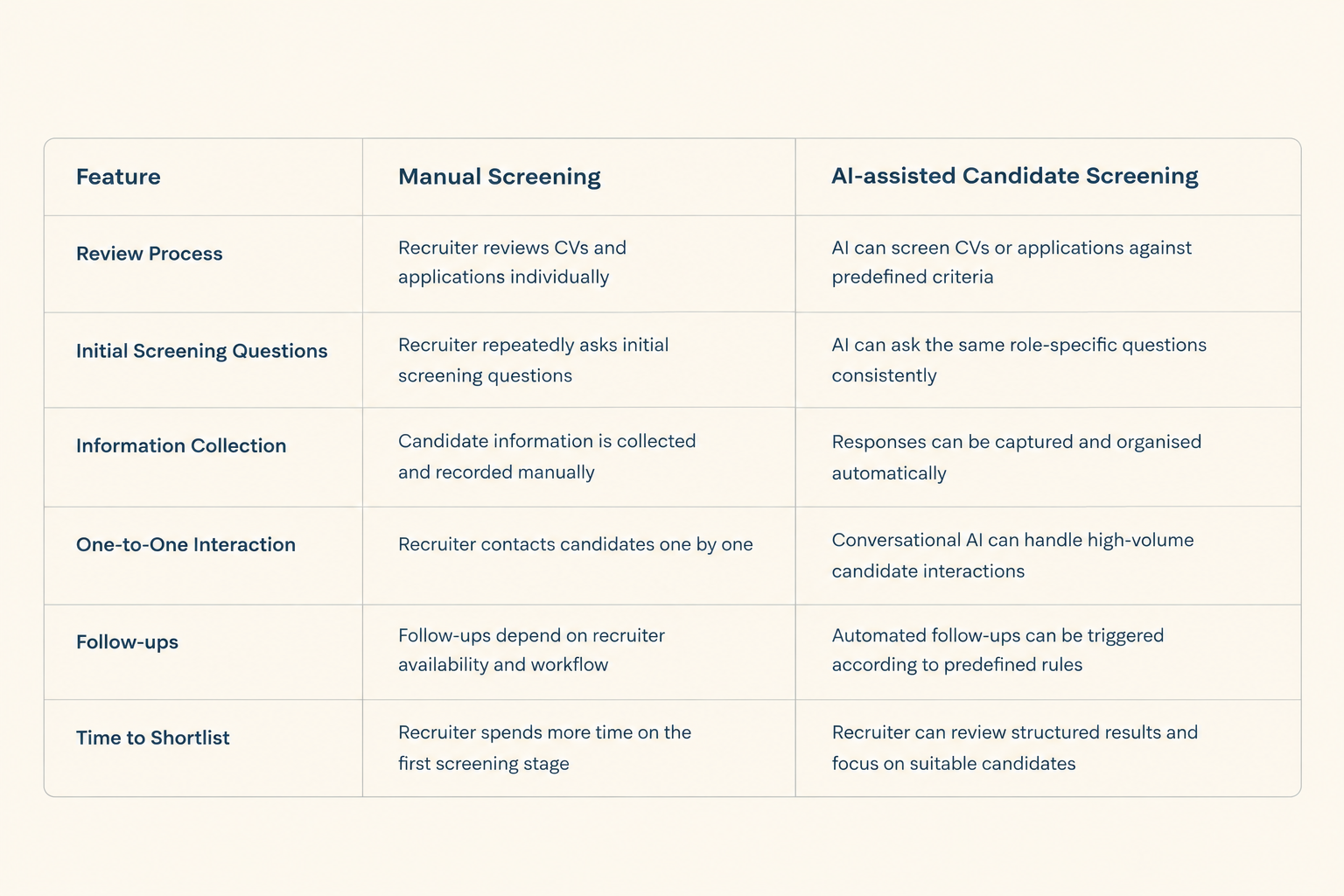
There is evidence behind some of these differences. The UK Government's Responsible AI in Recruitment guidance specifically identifies qualifying screening tools that can automatically sift and rank candidates using information from CVs and personal statements. It also recognises recruitment chatbots as tools that can engage with candidates and guide them through the recruitment process.
However, automation does not automatically mean better screening. Government guidance warns that AI screening systems can inherit bias from historical recruitment data and may disadvantage candidates because of factors such as employment gaps. The government also recommends ongoing performance monitoring, bias testing and meaningful human oversight.
Where AI Screening Adds the Most Value in Recruitment
Consider a recruitment agency hiring for a role that attracts a large number of applications. A recruiter still needs to identify which candidates have the required experience, confirm availability, check whether they are interested in the opportunity and move suitable candidates towards an interview. Doing this manually means repeating much of the same work for every applicant.
AI candidate screening can take over parts of this first stage. It can review available candidate information, conduct an initial conversation, ask role-specific questions and organise the responses for the recruiter. For agencies using conversational AI, this interaction does not have to stop at a CV or online form; candidates can also be screened through voice calls, WhatsApp or website chat, depending on the workflow.
The real advantage is the shift in where recruiter time is spent. Instead of using the first part of the process to establish basic information, recruiters can begin with a clearer picture of the candidate and concentrate on the assessment that actually requires their expertise.
This is particularly relevant to high-volume recruitment, where the challenge is not simply finding candidates but processing large numbers of applications and conversations without letting response times or candidate experience suffer. Indeed's current Smart Screening guidance similarly positions AI screening around reducing the time spent on initial review so hiring teams can focus on evaluating candidates.
There is a qualification, though: more automation does not automatically mean better hiring. Recent UK research found a gap between recruiter enthusiasm for AI and candidate confidence in how it is being used; CV-Library reported that 83% of surveyed recruiters said they use AI to make hiring more efficient, while 28% of candidates surveyed said they were less likely to apply when AI is involved.
That is why the strongest use of AI screening is not to create a completely automated hiring funnel. It is to make the first round more efficient, structured and responsive while keeping people responsible for the decisions that matter.
Where AI Candidate Screening Can Go Wrong
The appeal of automated candidate screening is easy to understand: recruiters can process more applications without manually reviewing every CV or conducting every first-round conversation. But speed alone does not make a screening process better.
The biggest concern is bias. An AI screening system may reproduce patterns in the data or criteria it has been built around. The UK Government's responsible AI in recruitment guidance specifically warns that screening and CV-matching tools can inherit bias from historical recruitment practices and may disadvantage certain groups of candidates.
There is also a risk of over-filtering. A candidate who does not use the exact terminology in a job description may still have the right experience. Similarly, employment gaps or unconventional career paths should not automatically be treated as evidence that someone is unsuitable.
For that reason, recruiters should regularly review screening outcomes, test the system for unintended bias and make sure there is a clear route for human review. The ICO's latest recruitment work places particular emphasis on monitoring, transparency and meaningful human involvement.
What AI Should and Shouldn't Decide
A useful way to introduce AI recruitment automation is to separate information gathering from hiring judgement.
AI can collect a candidate's experience, ask role-specific questions, confirm availability, organise responses and flag whether someone appears to meet clearly defined requirements. Those are structured tasks with relatively clear inputs and outputs.
The decision about whether a candidate is genuinely right for the organisation is different. Recruiters may need to consider communication, motivation, cultural context, career trajectory, client requirements and information that cannot be reduced to a simple score.
That makes AI-assisted candidate screening a more practical model than completely automated hiring. AI handles the repetitive first layer; recruiters remain responsible for evaluating the candidate and deciding what happens next.
Making Candidate Screening More Conversational
Not every candidate interaction needs to start and end with a CV or application form.
Conversational AI allows the first stage of screening to happen through an actual interaction. A candidate can answer questions, clarify an answer, ask a basic question about the vacancy and provide information that may not appear clearly on their CV.
For recruitment agencies, this can extend beyond one channel. Voice conversations, WhatsApp and website chat can all be used as part of a candidate communication workflow, depending on how the recruitment process is designed.
That makes the screening process more flexible while still keeping the recruiter in control of what information is collected and what happens after the conversation.
How to Start Automating Candidate Screening
Recruitment teams do not need to automate the entire screening process from day one.
A better approach is to identify one repetitive stage that takes up significant recruiter time. This could be asking the same qualification questions, confirming candidate availability or following up with applicants who have not responded.
From there, define the screening criteria, decide which questions the AI should ask, establish when a recruiter should take over and determine what information needs to be recorded in the ATS or CRM.
The results should then be measured using practical indicators such as screening completion, candidate response rates, recruiter time saved and progression to the next stage. This gives the team evidence for expanding automation rather than adopting AI simply because it is available.
Where Eumentis AI Fits Into Candidate Screening
For recruitment teams, conversational AI can sit between candidate outreach and recruiter review. An AI agent can contact candidates, conduct an initial screening conversation, collect role-specific information, answer routine questions and help move suitable candidates towards the next step.
Eumentis AI supports these conversational recruitment workflows across voice, WhatsApp and website chat, allowing businesses to automate repetitive candidate communication without removing recruiters from the process. The emphasis is on handling the conversations and routine actions that can be clearly defined, while recruiters remain involved where assessment, judgement or a more personal interaction is required.
Final Verdict: Should Recruiters Automate Candidate Screening?
AI candidate screening is most valuable when it is used to remove repetitive work, not recruiter responsibility.
For high-volume recruitment, AI can help manage the first layer of candidate interaction - from initial outreach and qualification to screening questions and follow-ups — and give recruiters more time to focus on candidates who warrant a closer assessment.
But effective automation requires more than a screening tool. The criteria need to be well defined, candidate data needs to be handled responsibly, and the system needs to be monitored for accuracy and unfair outcomes. Current UK guidance makes clear that organisations using AI in recruitment need to consider fairness, transparency, bias and human oversight rather than treating automation as a set-and-forget solution.
The practical question for a recruitment agency is therefore not “Can AI replace our first-round recruiters?” It is:
“Which parts of our first-round screening process are repetitive enough to automate, and where will human judgement create more value?”
That is where AI candidate screening becomes a useful recruitment strategy rather than simply another piece of technology.


