
A CXO Framework for Evaluating Production-Grade Voice AI Agents

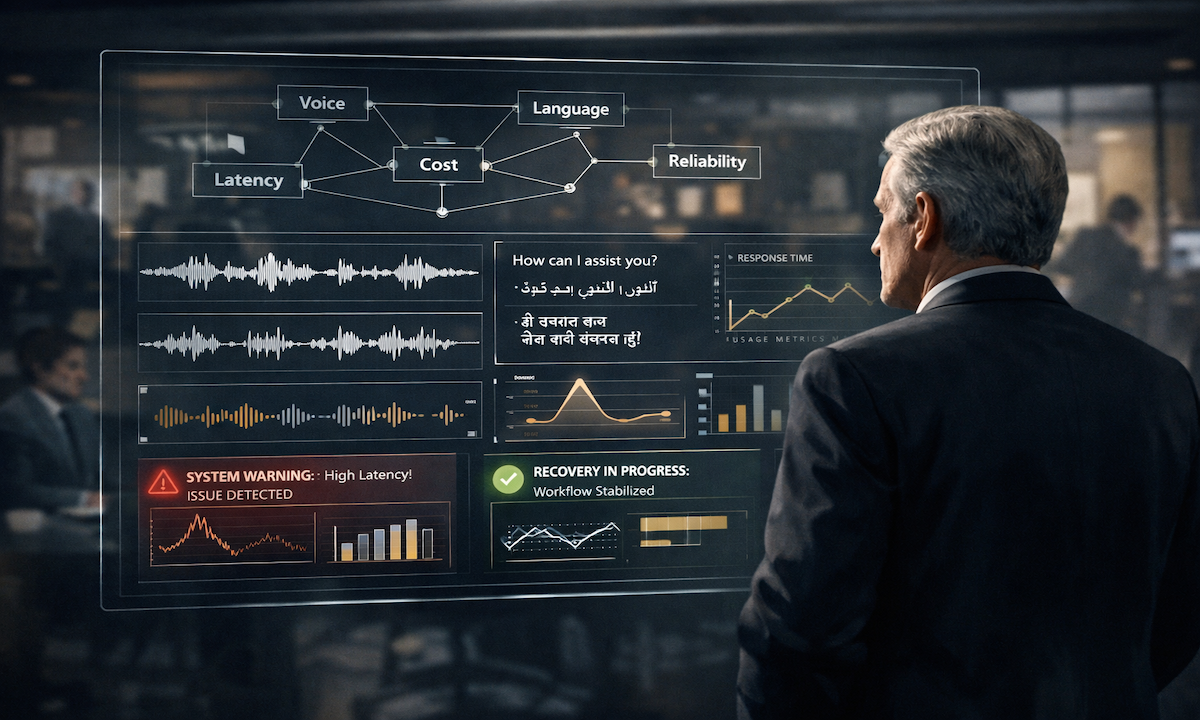
Why CXOs Need a New Framework to Evaluate Voice AI Agents
AI adoption has moved from experimentation to execution. CXOs are now expected to choose the best Voice AI Agents to run core business workflows—sales, customer experience, operations, and follow-ups, including the automation of real estate sales workflows at scale.
However, many leaders still evaluate AI the way they evaluate traditional software. This creates a gap between what AI agents promise and what AI agents actually deliver.
Unlike SaaS tools, Voice AI agents:
- interact with humans in real time
- operate under unpredictable inputs
- must respond instantly
- must recover from failure
- must scale economically
This makes evaluating AI agents a strategic decision, not a technical one.
AI agents are no longer experimental add-ons. They are increasingly being placed directly in revenue, customer experience, and operational workflows. A poorly evaluated AI agent does not just underperform—it creates customer friction, damages trust, and introduces hidden operational risk. This is why AI evaluation has moved from an IT concern to a CXO and board-level decision.
What Is a Voice AI Agent?
A voice AI agent is a system that listens to spoken input, reasons in real time, and takes autonomous action through natural speech to complete a defined business task.
In enterprise workflows, voice AI agents are used to:
- qualify inbound and outbound leads
- conduct discovery and qualification conversations
- schedule meetings and callbacks
- send voice-based reminders and follow-ups
- re-engage prospects after proposals or missed interactions
These workflows are already being executed at scale by voice AI sales agents handling real estate lead qualification and follow-ups in live production environments.
When CXOs evaluate voice AI agents, they are not evaluating intelligence in isolation — they are assessing how reliably these agents perform real conversations under real conditions: unpredictable users, varying languages, tight latency constraints, and production-level scale.
Why Demo-Based Evaluation of Voice AI Agents Fails
AI demos fail as an evaluation method because they do not reflect real conversational behaviour, real-world latency, multilingual complexity, or production-level scale.
Most voice AI agents appear impressive in demos. Many perform well in controlled environments with scripted inputs and ideal conditions. But once deployed in live workflows, predictable issues emerge:
- conversations go off-script
- latency disrupts natural interaction
- multilingual accuracy drops in real usage
- costs escalate faster than expected
- failures occur silently, without visibility
This gap between demo performance and production behaviour is why many organisations experience disappointing outcomes after deployment—even when the demo looked flawless.
The best voice AI agents are those that perform consistently outside the demo environment, under real user behaviour and real operational pressure.
When voice AI agents fail in production, the cost is rarely visible upfront. Missed conversations, delayed responses, and silent breakdowns compound into lost revenue, degraded customer experience, and increased manual rework. These costs are harder to quantify than licensing fees—but far more damaging over time.
The CXO Evaluation Framework for Voice AI Agents
Below is a practical, CXO-level framework to evaluate AI agents.
1. Start With the Business Use Case
CXOs should evaluate AI agents based on the exact business task they will perform, not on generic AI capabilities.
Before comparing the best Voice AI Agents, answer:
- What task will the AI agent perform?
- Is it customer-facing or internal?
- Does it require real-time interaction?
- Is accuracy more important than speed—or vice versa?
AI agents used for analytics are fundamentally different from AI agents used for live conversations. This distinction becomes critical when building AI-enabled sales teams that rely on live customer interactions. The best AI agents are always context-specific.
2. Understand the Decision Pathway of the Voice AI Agent
AI agents typically operate using prompt-driven or conversational pathways, and this choice directly impacts scalability and reliability.
Two common approaches:
Conversational Pathway
- state-based flows
- multiple branches
- harder to maintain as complexity increases
Prompt Pathway
- instruction-based reasoning
- easier iteration
In practice, many teams discover that conversational AI agents fail when workflows become complex.
3. Multilingual Capability Must Be Tested, Not Assumed
Multilingual AI agents often fail in production because language switching, accents, and pacing are harder than simple translation.
CXOs evaluating AI Agents should ask:
- Can the AI agent handle mixed-language inputs?
- Does accuracy drop in regional languages?
- Does the AI agent maintain conversational flow?
Many AI Agents advertise multilingual support, but few perform reliably beyond English. For markets like India and the Middle East, this is a make-or-break criterion when choosing the best AI agents.
4. Evaluate the Speech Layer: Accuracy, Latency, Naturalness
If the AI agent interacts via voice, three metrics matter:
The effectiveness of voice-based AI agents depends on speech accuracy, response latency, and voice naturalness.
CXOs should evaluate:
- How accurately the AI agent understands users
- How natural the AI agent sounds
- How quickly it responds
High latency breaks conversations. Perfect accuracy with slow responses still fails. The best AI agents strike a balance between performance, latency, and cost.
5. Production-Readiness vs Demo-Readiness
An AI agent is production-ready only if it behaves consistently under real load, real users, and real failure conditions.
Ask vendors:
- What happens when calls drop?
- How does the AI agent recover?
- Can failures be monitored?
- Are logs accessible?
6. Flexibility Matters More Than Feature Count
The best AI agents evolve as workflows, regulations, and customer behaviour change.
CXOs should check:
- Can scripts be updated easily?
- Can workflows change without rebuilding?
- Can multiple AI agents share learnings?
Rigid systems age quickly. Flexible AI agents last longer and deliver higher ROI.
7. Cost and Latency Compound at Scale
AI costs grow non-linearly at scale, making early cost evaluation critical for CXOs.
Evaluate:
- cost per interaction
- cost per minute
- retry costs
- failure costs
An AI agent that is affordable in a pilot may become unsustainable at scale. The best AI agents remain economically viable as usage grows.
8. Reliability Is a Board-Level Concern
AI agents operating in revenue or CX workflows cannot fail silently.
Reliable AI agents include monitoring, alerts, and clear failure handling mechanisms.
CXOs should demand:
- visibility into failures
- recovery mechanisms
- performance dashboards
The best AI agents prioritise reliability over novelty.
How CXOs Should Compare the Best AI Agents
When comparing the best AI Agents, use this evaluation lens:
- Use-case alignment
- Multilingual performance
- Latency under load
- Cost at scale
- Failure handling
- Ease of iteration
This ensures AI agents are compared on business outcomes, not marketing claims.
Why AI Agents Must Be Evaluated as Systems
AI agents are systems composed of perception, reasoning, response, and recovery—not single features.
Evaluating AI agents without understanding system behaviour leads to costly mistakes. The best AI agents operate reliably as complete systems.
Common CXO Mistakes When Evaluating AI Agents
- Overvaluing demos
- Ignoring multilingual complexity
- Underestimating latency
- Misjudging scale economics
- Treating AI agents as plug-and-play
Avoiding these mistakes significantly improves ROI.
Who Should Own AI Agent Evaluation?
Evaluating AI agents should not sit entirely with vendors, individual teams, or experimentation groups. Ownership should be shared between business leaders (who define outcomes), technical leaders (who assess system behaviour), and operations teams (who manage scale and reliability). Without clear ownership, even the best AI Agents can fail to deliver value.
CXO Checklist: Evaluating Voice AI Agents
Ask these before approving any AI agent:
- Does it work under real conditions?
- Does it handle failure gracefully?
- Does it scale economically?
- Does it support our languages?
- Can it evolve with our business?
If the answer to any is unclear, the agent is not among the best AI agents for your organisation.
Final Thought for CXOs
The organisations that succeed with AI will be those whose leaders evaluate AI agents rigorously, patiently, and strategically.


